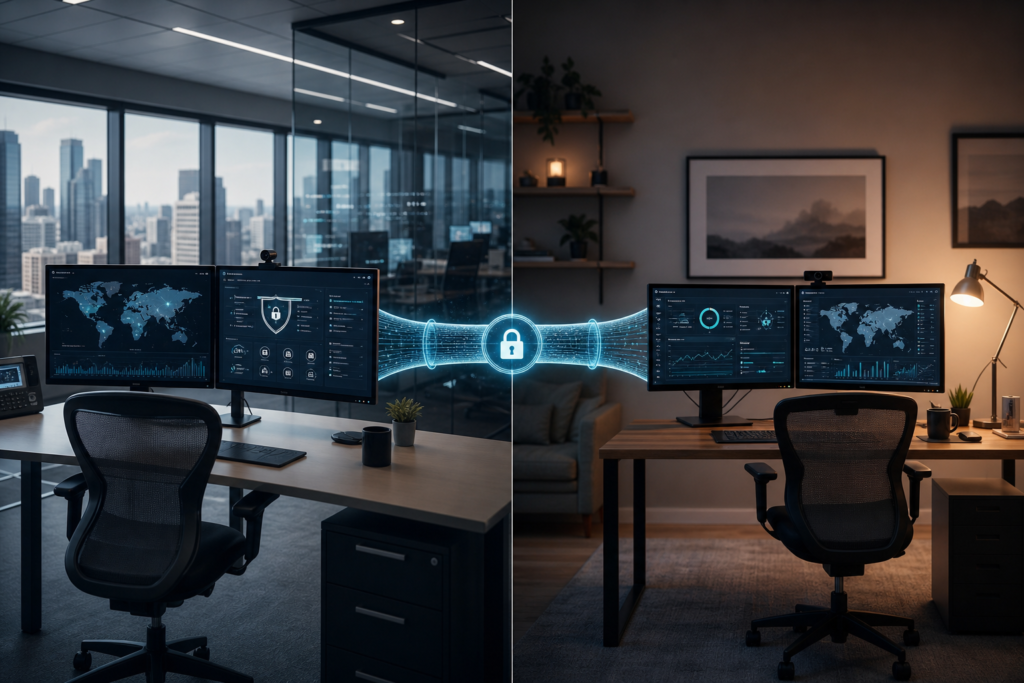
74% of Professional Firms Now Face Security Breaches via Remote Access: The 2026 Hybrid Work IT Security Playbook
The most effective hybrid work IT security strategy for professional services in 2026 is the complete replacement of traditional VPNs with a Zero Trust Network Access (ZTNA) architecture that verifies every user, device, and connection regardless of location. At Transform 42 Inc, we have seen that firms relying on legacy “perimeter” security are 3.5 times more likely to suffer a data breach than those utilizing identity-based micro-segmentation. For Miami-based law firms, accounting practices, and medical groups, security is no longer about the office walls; it is about the integrity of the individual identity and the health of the endpoint device.
I am Joe Crist, CEO of Transform 42 Inc. As a Service-Disabled Veteran-Owned Small Business, we approach IT security with the same discipline and precision required in military operations. In the South Florida business environment—where hurricane season often forces sudden shifts to remote work and the regulatory landscape for HIPAA and IRS compliance is tightening—your IT infrastructure must be resilient, portable, and impenetrable. This playbook outlines how to secure your firm in the modern hybrid era.
The Death of the VPN and the Rise of Zero Trust
Traditional Virtual Private Networks (VPNs) are the single greatest vulnerability for hybrid firms in 2026 because they grant broad network access once a single set of credentials is compromised. To achieve true hybrid work IT security professional services 2026 standards, firms must transition to Zero Trust. This means your network assumes every connection is a threat until proven otherwise through continuous verification.
We recommend implementing Zscaler or Microsoft Entra ID Conditional Access. These tools ensure that an attorney in Coral Gables or a CPA in Brickell can only access the specific files they need, and only if their laptop meets strict security health checks. This aligns with NIST SP 800-46 guidelines, which emphasize securing the “enterprise edge” rather than just the office building.
Why Conditional Access is Non-Negotiable
Conditional Access policies act as your digital bouncer. If a staff member tries to log into OneDrive from an unmanaged personal tablet or a coffee shop in Miami Beach with an insecure Wi-Fi connection, the system automatically blocks access. This level of granular control is what separates professional-grade security from amateur setups.
Endpoint Management: Securing the Device, Not the Desk
In a hybrid model, the laptop is your new office, and it must be managed as a high-security asset using Mobile Device Management (MDM). We utilize Microsoft Intune to push security updates, enforce encryption, and remotely wipe data if a device is lost or stolen. This is a core component of our managed IT services.
For threat detection, legacy antivirus is obsolete. You need Endpoint Detection and Response (EDR). We lead with CrowdStrike, which uses artificial intelligence to stop breaches in real-time. As industry leader Karl Palachuk often notes, the “standard” for small business IT has shifted from reactive maintenance to proactive, continuous monitoring.
| Security Feature | Legacy Approach (Pre-2024) | Modern Hybrid Standard (2026) |
|---|---|---|
| Network Access | Hardware VPN (Slow/Vulnerable) | Zero Trust Network Access (ZTNA) |
| Antivirus | Signature-based (Reactive) | EDR/XDR (AI-driven Prevention) |
| Device Policy | “Bring Your Own Device” (BYOD) | Managed MDM (Intune) |
| Authentication | Simple Passwords | Phishing-Resistant MFA |
Compliance Across Locations: HIPAA, IRS, and ABA Standards
Regulatory bodies do not care if your employee is sitting in your Miami office or their home office in Kendall; the data protection requirements remain the same. For our clients in healthcare, adhering to HIPAA remote work guidance is mandatory. This includes ensuring that PHI (Protected Health Information) is never stored locally on a home computer.
For accounting firms, IRS Publication 4557 mandates a written information security plan that covers remote access. Similarly, law firms must maintain attorney-client privilege as outlined in ABA Formal Opinion 477R, which highlights the duty to use secure communication channels when transmitting sensitive client data.
The Physical Security Gap
We often see firms forget physical security for remote workers. In Miami, where high-density living is common, we advise on “shoulder surfing” prevention and the use of privacy screens. Furthermore, home printing is a major data leak. We recommend strict policies—enforced by software—that prevent the printing of sensitive documents to unmanaged home printers.
Secure Collaboration: Teams, SharePoint, and Data Loss Prevention
Collaboration tools like Microsoft Teams and SharePoint are the lifeblood of the hybrid firm, but they must be governed correctly. Without Data Loss Prevention (DLP) policies, a well-meaning employee could easily share a folder containing Social Security numbers or medical records with an external party.
At Transform 42 Inc, we configure DLP to automatically scan files for sensitive patterns. If a document is flagged, it cannot be shared externally without senior-level approval. This level of oversight is critical for law firms handling discovery documents or accounting firms managing tax returns. We also look to CISA telework guidance to ensure our collaboration configurations meet federal hardening standards.
Shadow IT and Home Network Hardening
Shadow IT—the use of unauthorized software like personal Dropbox accounts or unapproved messaging apps—is the “silent killer” of hybrid work IT security professional services 2026. Employees often use these tools to bypass perceived friction in firm-provided systems. Our role as your IT partner is to provide tools that are so seamless that employees have no reason to look elsewhere.
We also provide guidance for the “Home Office Perimeter.” While you cannot manage an employee’s entire home network, you can require certain standards. We often recommend or provide business-grade hardware like Cisco Meraki or Fortinet teleworker gateways. These devices create a secure, encrypted tunnel directly to the firm’s resources, completely isolating work traffic from the employee’s home Netflix streaming or smart appliances.
Why a Service-Disabled Veteran-Owned Small Business is Your Best Ally
In the military, security is not a suggestion; it is a requirement for mission success. As a Service-Disabled Veteran-Owned Small Business, Transform 42 Inc brings that mission-critical mindset to the private sector. We don’t just “fix computers.” We protect the livelihoods of our clients and the privacy of their customers.
Our approach is direct and transparent. We tell you what you need to hear, not what is easiest to sell. In a city like Miami, where the business pace is fast and the risks (from cybercrime to climate) are high, you need a partner who understands the value of discipline and standardized procedures.
Conclusion: Your 2026 Security Roadmap
The transition to hybrid work is no longer a temporary fix; it is the permanent state of professional services. To protect your firm, you must move beyond the “good enough” security of the past. This means adopting Zero Trust, mastering endpoint management with Intune and CrowdStrike, and ensuring your compliance posture is ironclad across all locations.
Don’t wait for a breach to realize your remote access is vulnerable. Take the first step toward a secure, resilient future today. Transform 42 Inc is ready to lead the way.
Ready to secure your firm? Contact us today or schedule a free IT assessment to see how your current hybrid setup measures up against 2026 standards.
Frequently Asked Questions
Is a VPN enough to secure my remote employees in 2026?
No, a VPN is no longer sufficient because it creates a single point of failure and often allows lateral movement across your network once breached. Modern firms should transition to Zero Trust Network Access (ZTNA), which verifies every request individually and limits access to specific applications rather than the entire network.
How do I ensure my firm stays HIPAA compliant with staff working from home?
HIPAA compliance in a hybrid environment requires strict endpoint management to ensure no Protected Health Information (PHI) is stored on local, unencrypted drives. You must use managed devices with remote-wipe capabilities and ensure all remote access occurs through encrypted, authenticated channels that log all activity.
Can we allow employees to use their personal computers for work (BYOD)?
While BYOD is possible, it is highly discouraged for professional firms due to the extreme security risks of unmanaged hardware. If you must allow it, you should use a Virtual Desktop Infrastructure (VDI) or secure “enclave” software that keeps firm data completely isolated from the personal operating system.
What is the biggest security threat to Miami firms during hurricane season?
Beyond physical damage, the biggest threat is the rapid, unmanaged shift to remote work which often leads to “security shortcuts” that hackers exploit. Having a pre-configured, Zero Trust-based hybrid infrastructure ensures that your team can work securely from anywhere the moment a storm approaches without compromising data integrity.
What is the benefit of working with a Service-Disabled Veteran-Owned Small Business for IT?
Working with a Service-Disabled Veteran-Owned Small Business ensures a level of operational discipline, ethical standards, and attention to detail that is often missing in the IT industry. We view your firm’s security as a mission-critical objective and apply rigorous, military-grade frameworks to protect your data and reputation.
Stay Ahead of IT Risks in Your Industry
Weekly insights on cybersecurity, compliance, and IT strategy for accounting firms, law firms, and medical practices.