TL;DR:
- Miami professionals face high litigation risk requiring layered protection beyond basic insurance.
- Building operational independence and strong documentation are crucial for mitigating threats and defending claims.
- Diversifying wealth and conducting regular risk assessments enhance long-term practice resilience.
If you practice medicine, law, or accounting in Miami, you already carry more risk than most professionals in the country realize. Miami-Dade County consistently ranks among the most litigious jurisdictions in the United States, and the combination of complex regulatory requirements, high client expectations, and a competitive market creates a pressure cooker that basic malpractice insurance simply cannot contain. The professionals who build lasting, profitable practices here are not the ones who avoid risk entirely. They are the ones who manage it with precision, using layered strategies that protect clients, shield personal assets, and create competitive advantages that smaller, less prepared firms cannot match.
Table of Contents
- Securing the right insurance coverage: Beyond the basics
- Operational independence: Reducing single-point risk
- Documentation and client communication: Defensible practices
- Compliance and cybersecurity: Miami’s evolving regulatory landscape
- Diversifying wealth and business assets: Staying resilient
- What most risk guides overlook: Building a personalized, layered defense
- Enhance your Miami practice: Next steps for advanced risk management
- Frequently asked questions
Key Takeaways
| Point | Details |
|---|---|
| Insurance is essential | Adequate coverage and critical add-ons protect against high-cost claims and contractual requirements. |
| Layered defense works best | Combine insurance, operational independence, and strong documentation to reduce risk and increase profitability. |
| Compliance is non-negotiable | Miami-specific regulatory and cybersecurity requirements must be actively managed for all professionals. |
| Diversify wealth | Limit practice equity exposure and channel profits into multiple asset classes for resilience. |
| Best practices earn savings | Engagement letters and regular training can earn insurance credits and lower premiums. |
Securing the right insurance coverage: Beyond the basics
Now that we’ve established the need for more than basic protection, let’s examine the insurance layer, your first line of defense.
Professional liability insurance is the foundational risk control across all three professions. For doctors, that means malpractice coverage. For lawyers, it is Lawyers Professional Liability (LPL). For accountants, it is Errors and Omissions (E&O). But too many Miami practitioners treat these policies as checkbox items rather than strategic tools.
The details inside your policy matter enormously. Three add-ons deserve your immediate attention:
- Tail coverage: Protects you from claims filed after a policy ends, which is critical if you switch carriers or retire.
- First Dollar Defense: Ensures your insurer pays legal defense costs from dollar one, without requiring you to hit a deductible first.
- Consent to Settle clause: Gives you the right to approve or reject any settlement offer, protecting your professional reputation.
Miami’s litigation environment directly affects your premium structure. High claim frequency in South Florida drives insurers to price policies higher than national averages, and many institutional clients and hospital systems now contractually require at least $1M per occurrence and $3M aggregate coverage before they will engage your services. The Florida liability insurance market has specific requirements and nuances that can surprise out-of-state practitioners or those who have not reviewed their policies recently.
Here is a quick comparison of key policy features across the three professions:
| Profession | Policy type | Typical coverage | Key add-ons |
|---|---|---|---|
| Doctor | Medical malpractice | $1M/$3M minimum | Tail coverage, Consent to Settle |
| Lawyer | LPL (Lawyers Professional Liability) | $1M/$3M minimum | First Dollar Defense, cyber rider |
| Accountant | E&O (Errors and Omissions) | $500K/$1M minimum | First Dollar Defense, data breach rider |
Pro Tip: Your LLC or professional corporation does not protect your personal assets from a professional negligence claim. Courts routinely pierce that veil when malpractice is at issue. As detailed in solo practitioner asset protection resources, insurance remains your primary firewall. Do not let anyone convince you otherwise.
For more on how coverage requirements apply specifically to accounting practices, the risk management tips for Miami accounting guide covers the nuances Miami CPA firms need to understand.
Operational independence: Reducing single-point risk
Insurance is a strong foundation, but structural and operational independence can prevent risks from ever materializing.
One of the most underappreciated vulnerabilities in Miami’s professional service firms is key-person dependency. When your practice’s revenue, client relationships, or critical processes depend entirely on one person (usually you), any disruption becomes an existential threat. Illness, a family emergency, or even a competitor recruiting your top associate can destabilize everything you have built.
Building operational independence means reducing that dependency through documented processes, redundant roles, and the strategic use of external consultants. Here is what that looks like in practice:
- Document every critical workflow so that any trained team member can execute it without your direct oversight.
- Cross-train staff across client-facing and back-office functions to eliminate single points of failure.
- Engage specialized consultants for HR, IT, and financial planning so these functions continue operating even when your team is stretched.
- Use technology platforms that give multiple authorized users access to client data, calendars, and task management.
Miami’s fast-growing market also creates a specific trap: over-expansion. Practices that scale too fast often outpace their operational infrastructure, creating compliance gaps and service delivery failures that attract exactly the kind of claims you are trying to avoid. Steady, process-driven growth is far more defensible than rapid hiring without systems to support it.
“The firms that survive disruption are not the largest. They are the ones with the clearest processes and the most distributed decision-making.”
The building agile teams Miami CPA framework offers practical models for distributing responsibility across a growing team without sacrificing quality or control.
Pro Tip: Document your cross-training plan formally and review it at least once a year. If a key team member left tomorrow, how long would it take to restore normal operations? If the answer is more than two weeks, your operational risk is already elevated.
Documentation and client communication: Defensible practices
Operational independence works hand-in-hand with reliable records and client communication, both essential for defending against claims.

Across all three professions, poor documentation is the single biggest factor that turns a manageable dispute into a career-altering lawsuit. When a client claims you gave bad advice, missed a deadline, or failed to disclose a risk, your records are your defense. Strong documentation does not just reduce claim likelihood; it also puts you in a far stronger negotiating position if a claim does arise.
Implementing robust documentation and clear client communication protocols is now considered a baseline professional standard, not an extra step. Here is what that means for each profession:
Doctors:
- Maintain detailed diagnostic notes for every patient encounter, including the reasoning behind each clinical decision.
- Use signed informed consent forms for every procedure, updated to reflect current standards.
- Document all follow-up communications, including phone calls and patient-initiated messages.
Lawyers:
- Draft clear engagement letters that define the scope of representation with precision.
- Implement a robust docketing system so no deadline is missed.
- Send written confirmations after all substantive client conversations.
Accountants:
- Create detailed workpapers for every engagement, capturing the data relied upon and the reasoning applied.
- Document all advice given, especially when clients override your recommendations.
- Use signed engagement letters that set explicit expectations on deliverables and timelines.
One strategic benefit of strong documentation often goes unnoticed: insurance credits and premium reductions. Carriers reward firms that demonstrate disciplined risk controls through lower premiums. Strong engagement letters, staff training logs, and documented communication protocols can directly lower your annual insurance costs, turning risk management into a profitability driver.
The risk management best practices Miami guide provides templates and checklists specifically designed for South Florida professionals.
Pro Tip: Build a template library for all client agreements, engagement letters, and consent forms. Standardized templates reduce errors, save time, and ensure every client relationship starts on legally defensible ground.
Compliance and cybersecurity: Miami’s evolving regulatory landscape
With records and communication in place, regulatory compliance and cybersecurity form your next protective layer.
Miami’s diverse, international client base and its high concentration of healthcare, legal, and financial services create a uniquely intense compliance environment. Regulatory violations here do not just generate fines. They generate headlines, and in Miami’s professional community, your reputation travels fast.
Regulatory compliance and cybersecurity are now inseparable risk management concerns, especially as remote and hybrid work have expanded the attack surface for data breaches. Here is a sector-by-sector breakdown of the minimum controls each profession needs:
| Profession | Compliance priority | Cybersecurity requirement |
|---|---|---|
| Doctor | HIPAA audits, annual staff training | Encrypted patient records, breach response plan |
| Lawyer | Florida Bar ethics rules, e-discovery readiness | Secure remote access, cyber liability insurance |
| Accountant | IRS data security requirements, state tax updates | Multi-factor authentication, client portal encryption |
For accountants specifically, annual tax law updates are not just professional development. They are a compliance obligation. Failing to apply a new provision that harms a client’s tax position is exactly the kind of claim that E&O policies handle, but one that documentation and training can prevent entirely.
Lawyers operating in hybrid environments face additional exposure. The cybersecurity for Miami CPAs resource outlines the specific controls that protect client data in distributed work settings, many of which apply equally well to law firms. A comprehensive IT risk assessment is often the fastest way to identify compliance gaps you did not know existed.
Cyber insurance is no longer optional for any Miami professional. A single data breach involving client financial records or protected health information can generate six-figure notification, remediation, and legal costs before any litigation even begins.
Diversifying wealth and business assets: Staying resilient
Compliance and business controls are effective, but financial resilience ensures you can weather setbacks even if all else fails.
Many Miami professionals build highly profitable practices and then make one critical mistake: they leave most of their net worth inside the practice itself. That concentration creates enormous exposure. If the practice faces a catastrophic claim, loses a key contract, or suffers an operational disruption, both your business and your personal financial security are at risk simultaneously.
Diversifying personal wealth away from practice equity is one of the most important and most neglected risk management strategies available to independent professionals. The general guideline is clear: no more than 50% of your net worth should be tied to practice equity at any point in your career.
Here is a practical framework for building financial resilience outside your practice:
- Maximize retirement account contributions each year. SEP-IRAs, defined benefit plans, and 401(k) structures all offer tax advantages while building protected assets.
- Invest in Miami real estate strategically, particularly income-generating properties that provide cash flow independent of your professional practice.
- Build a diversified securities portfolio across stocks, bonds, and index funds to capture market growth without concentration in any single sector.
- Maintain a dedicated emergency fund equal to at least six months of practice operating expenses, held outside your business accounts.
- Review your allocation annually to rebalance as your practice grows and market conditions change.
Miami’s real estate market offers unique opportunities for wealth building, but it also carries its own concentration risk. Diversification means spreading across asset classes, not just buying multiple properties.
Connecting your financial resilience strategy with your IT security governance supports both goals. The IT security governance Miami resource outlines how protecting your practice’s technology infrastructure directly supports its long-term valuation and stability.
Pro Tip: Schedule an annual wealth audit with a fee-only financial advisor who has no product to sell you. Review your asset allocation, your insurance coverage, and your estate plan in a single session. Most high-earning professionals are surprised by what they find.
What most risk guides overlook: Building a personalized, layered defense
Having explored each key strategy, let’s reflect on what truly drives results, and what many experts miss.
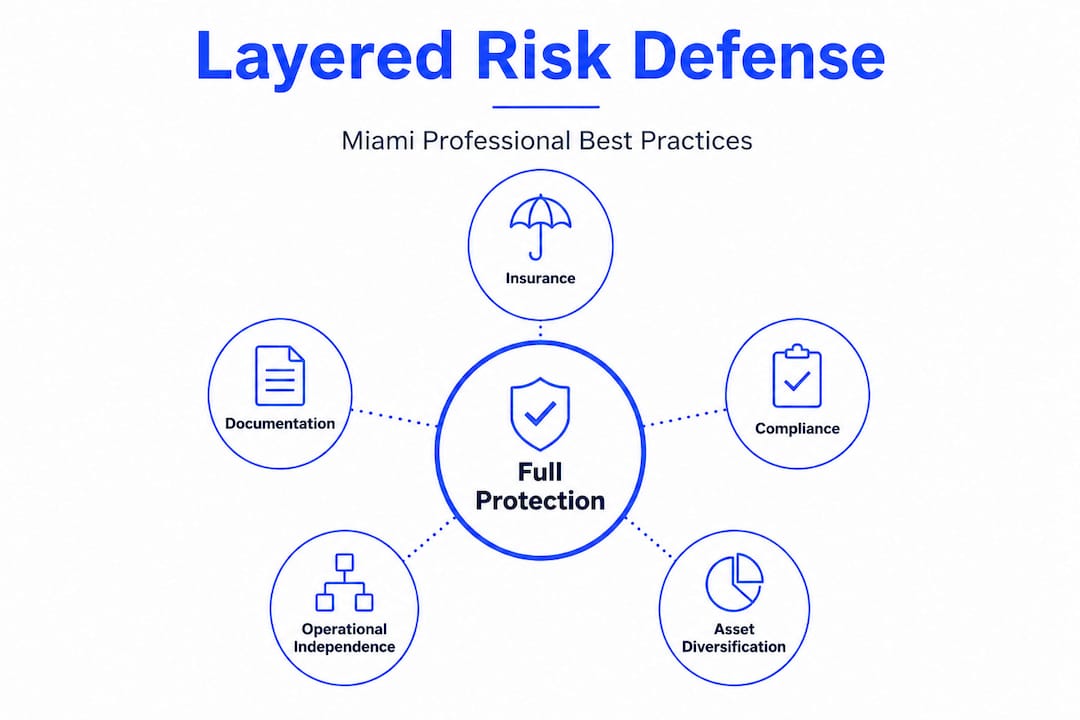
Most risk management articles treat each strategy as a standalone item: get insurance, document your work, stay compliant. What they rarely say is that none of these strategies works well in isolation. Miami’s risk landscape is too complex and too fluid for a checklist approach. What you actually need is a layered defense where each element reinforces the others.
Think of it this way. Insurance pays for claims after they happen. Documentation reduces the likelihood of claims and strengthens your defense when they do. Operational independence ensures a single disruption cannot cascade into total failure. Compliance controls eliminate the regulatory triggers that invite government scrutiny. Wealth diversification ensures that even a worst-case outcome does not destroy your personal financial future.
The temptation that going bare creates is real and worth addressing directly. Some practitioners forgo professional liability insurance to save on premiums, reasoning that their documentation and client relationships make them low risk. The problem is that insurance provides a legal defense even for completely baseless suits, and baseless suits are expensive to defend. One unfounded malpractice claim can cost $50,000 or more in legal fees before it is dismissed. That is not a risk worth taking to save a few thousand dollars a year in premiums.
We also see Miami professionals underestimate how quickly the risk landscape changes. New cybersecurity threats for Miami CPAs emerge every year, regulatory requirements evolve, and the litigation environment shifts. A strategy that was adequate three years ago may have material gaps today.
Our perspective: schedule a formal risk review every year, ideally in the fourth quarter before renewal season. Assess your insurance coverage against current contract requirements, audit your documentation practices, review your compliance status, and stress-test your operational resilience. Treat it the same way you treat your annual financial audit. It is not optional; it is professional discipline.
Enhance your Miami practice: Next steps for advanced risk management
Ready to build your next layer of protection? Explore tailored solutions for Miami doctors, lawyers, and accountants.
The strategies in this article are powerful, but they require the right technology infrastructure to implement consistently and at scale. Manual documentation systems break down under pressure. Compliance monitoring falls behind without automation. Operational independence is impossible without platforms that give your team seamless access to the tools and data they need.
We help Miami doctors, lawyers, and accountants integrate technology solutions that turn these risk management strategies into daily operational reality. From purpose-built IT services for doctors that support HIPAA compliance and secure patient records, to digital transformation resources that modernize your entire practice workflow, our team builds the capabilities your clients expect and the compliance your practice demands. Scale without proportional hiring. Land bigger clients. Reclaim your time.
Frequently asked questions
What level of professional liability insurance coverage is recommended for Miami doctors, lawyers, and accountants?
Most contracts in Miami require at least $1M/$3M minimum coverage; specialists and high-risk sectors may need higher limits given Miami-Dade’s elevated claim frequency and litigation environment.
Can a professional LLC or PC protect personal assets from negligence lawsuits?
No, neither an LLC nor a professional corporation shields your personal assets from professional negligence claims; insurance remains your primary and most reliable defense.
How much should I invest outside my practice to mitigate risk?
Experts recommend keeping no more than 50% of your net worth in practice equity and diversifying through real estate, retirement accounts, and securities.
Does improving client communication help reduce insurance premiums?
Yes, strong engagement letters and protocols can earn insurance credits that directly lower your annual premiums, making risk management a profitability strategy, not just a cost.
What Miami-specific compliance risks should I prioritize?
Focus on HIPAA audits and training for doctors, secure remote work policies and cyber insurance for lawyers, and annual tax law compliance updates for accountants.
Recommended
- 7 Essential Risk Management Tips For Miami Accounting Firms
- 7 Risk Management Best Practices For Miami Accounting Firms
- 7 Project Risk Management Best Practices For Miami CPAs
- IT Risk Assessment Steps For Miami Accounting Firms
- AML, CTF and Risk Management for VASPs
- Master risk management in accounting for SME success | Ready Accounting