
TL;DR:
- Basic cybersecurity foundations like the CIA triad and MFA are crucial for practice resilience.
- Regular risk assessments and compliance with HIPAA, GLBA, and PCI DSS prevent costly fines.
- Consistent staff training and monitoring transform cybersecurity from reactive to proactive.
A Miami-based physician recently faced a $2.1 million OCR fine after a routine audit revealed her practice had never completed a formal risk analysis. No breach occurred. No patient data was stolen. The penalty came purely from a compliance gap she didn’t know existed. For independent doctors, lawyers, and accountants in Miami, the stakes around cybersecurity are no longer theoretical. Knowing what to learn, and in what order, is the difference between building a resilient practice and facing regulatory consequences that can derail years of hard work.
Table of Contents
- Understand the core cybersecurity concepts
- Know your compliance landscape: HIPAA, GLBA, and PCI DSS essentials
- Implement the NIST Cybersecurity Framework (CSF) in your practice
- Train your staff and yourself: Prevent breaches before they start
- Verify and monitor: How to know your cybersecurity works
- Our take: Why foundational security skills matter more than ever
- Take action: Transform your cybersecurity with expert support
- Frequently asked questions
Key Takeaways
| Point | Details |
|---|---|
| Start with cybersecurity fundamentals | Master the basics like the CIA triad and encryption before moving to advanced topics. |
| Know your compliance duties | Identify which laws (HIPAA, GLBA, PCI DSS) apply to your practice and address them early. |
| Implement NIST CSF for structure | Use the NIST Cybersecurity Framework to shape your risk management approach. |
| Prioritize ongoing training | Regularly update both your own and your staff’s knowledge to stay ahead of threats. |
| Monitor and verify regularly | Regular risk assessments and monitoring are essential for compliance and peace of mind. |
Understand the core cybersecurity concepts
To build security habits that work, start by mastering the basic pillars. These fundamentals apply whether you run a solo medical practice, a boutique law firm, or an accounting office handling high-net-worth clients.
The CIA triad forms the backbone of every cybersecurity decision you will ever make. Confidentiality means only authorized people access your data. Integrity means that data is accurate and unaltered. Availability means your systems are accessible when you and your clients need them. Every security tool, policy, or procedure you adopt should map back to at least one of these three principles.
Networking basics are equally critical. You don’t need to become a network engineer, but you do need to understand how TCP/IP works, what a firewall does, and why network segmentation protects sensitive data. For example, keeping your patient records system on a separate network segment from your general office Wi-Fi dramatically reduces your exposure if a device gets compromised.
Operating system proficiency matters too. Linux commands help you navigate servers and logs. Windows Active Directory is the backbone of user management in most professional offices, controlling who has access to what. Understanding how to manage permissions inside Active Directory is a practical skill that directly reduces your risk of insider threats and credential theft.
Authentication is where many practices fall short. Multi-factor authentication (MFA) should be non-negotiable for every login that touches client data. Pair that with the principle of least privilege, meaning users only access the data they need to do their job, nothing more. Strong, unique passwords managed through a dedicated password manager round out this layer.
Encryption standards you must recognize include AES-256, which is the current gold standard for protecting data both at rest and in transit. If your electronic health records system or client portal doesn’t use AES-256 encryption, that’s a gap worth addressing immediately. Our complete cybersecurity guide walks through how to audit these settings in common professional software.
| Concept | What it protects | Why it matters for your practice |
|---|---|---|
| CIA Triad | All data assets | Foundation for every security decision |
| MFA | User accounts | Stops 99% of credential-based attacks |
| AES-256 Encryption | Data at rest and in transit | Required by HIPAA, GLBA, and PCI DSS |
| Least Privilege | Internal systems | Limits damage from insider threats |
| Firewall/Network Segmentation | Network perimeter | Blocks unauthorized external access |
Key foundational skills to prioritize:
- Learn how to configure and verify MFA on your email, EHR, and practice management software
- Review your Windows Active Directory user roles at least quarterly
- Confirm your cloud storage and backup solutions use AES-256 encryption
- Establish a strong password policy and deploy a password manager for your team
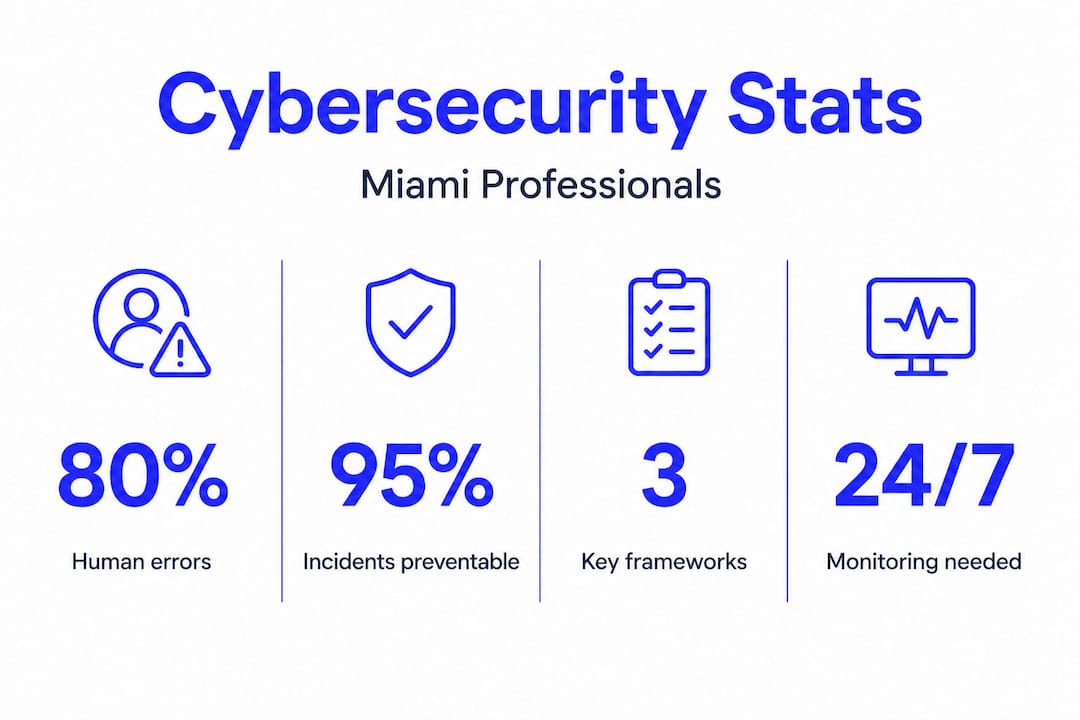
Pro Tip: Nail these fundamentals before pursuing advanced certifications or niche tools. Eighty percent of breaches exploit basic gaps that foundational knowledge directly addresses. When you practice cyber security consistently at this level, you close the most common attack vectors quickly and cost-effectively.
Know your compliance landscape: HIPAA, GLBA, and PCI DSS essentials
Once you have the basics down, align them with the compliance obligations unique to your field. Miami professionals operate under a layered set of federal regulations, and each one carries specific cybersecurity requirements.
HIPAA governs medical professionals and requires a formal risk analysis, documented security policies, and workforce training. The Office for Civil Rights (OCR) has levied millions in fines for missing risk analyses alone, even when no breach occurred. Phishing and weak passwords remain the most common causes of healthcare breaches, which means training is not optional.

GLBA applies to accountants and financial advisors who handle nonpublic personal financial information. The FTC’s Safeguards Rule under GLBA now mandates annual penetration testing and vulnerability assessments. If your accounting firm hasn’t scheduled a pen test, you’re already behind.
PCI DSS v4.0 applies if your practice processes credit card payments. The 12 PCI DSS requirements cover network security, access controls, data protection, and ongoing monitoring. The scope of your compliance burden shrinks significantly if you use tokenization, which replaces sensitive card data with a non-sensitive token so your systems never actually store raw card numbers.
“The cost of missing a risk analysis can be millions in fines.”
| Regulation | Who it applies to | Key cybersecurity requirement |
|---|---|---|
| HIPAA | Physicians, therapists, clinics | Annual risk analysis, workforce training, encryption |
| GLBA | Accountants, financial advisors | Annual pen testing, incident response plan |
| PCI DSS v4.0 | Any practice accepting card payments | 12-point security program, tokenization recommended |
Critical compliance actions to take now:
- Schedule your annual HIPAA risk analysis if you haven’t done so this year
- Engage a qualified vendor for your GLBA-mandated penetration test
- Review whether tokenization can reduce your PCI DSS scope
- Document all security policies and keep them updated
Pro Tip: Use tokenization to minimize your PCI DSS compliance scope. It’s one of the fastest ways to reduce the number of systems that fall under PCI requirements, which directly cuts your audit burden and cost.
Understanding cybersecurity best practices specific to your profession isn’t just about avoiding fines. It’s about understanding why cybersecurity is important as a competitive differentiator. Clients increasingly choose professionals who can demonstrate that their data is protected.
Implement the NIST Cybersecurity Framework (CSF) in your practice
Understanding the regulatory environment sets the stage for building a well-structured security program. The NIST Cybersecurity Framework 2.0 gives you a practical, flexible structure to do exactly that.
NIST CSF 2.0 organizes security activities into six core functions: Govern, Identify, Protect, Detect, Respond, and Recover. Each function maps directly to real activities you can implement in a professional services setting, regardless of your practice size.
Here’s how to apply each function step by step:
- Govern: Establish a written security policy that defines roles, responsibilities, and acceptable use of technology in your practice. Even a one-page document is better than nothing.
- Identify: Create an asset inventory. List every device, software application, and cloud service that touches client data. You can’t protect what you don’t know exists.
- Protect: Implement access controls using the least privilege principle. Enable MFA on all critical systems. Encrypt sensitive files and backups. Update software and firmware regularly.
- Detect: Deploy monitoring tools that alert you to unusual login attempts, data transfers, or system changes. Many cloud platforms include basic monitoring at no extra cost.
- Respond: Write a simple incident response plan. It should cover who to call, how to contain a breach, and how to notify affected clients and regulators. Practice running through it at least once a year.
- Recover: Test your data backups regularly. A backup that hasn’t been verified is just a false sense of security. Schedule quarterly recovery drills to confirm your data can be restored quickly.
Improving cybersecurity awareness across your team is part of the Protect and Detect functions. Awareness training directly reduces the human error that accounts for the majority of successful attacks. Addressing cybersecurity vulnerabilities systematically through this framework means you’re not reacting to crises but preventing them.
Pro Tip: Even a solo practice benefits enormously from formalizing an incident response and recovery plan. When something goes wrong, having a written plan prevents panic and reduces the time it takes to contain the damage.
Train your staff and yourself: Prevent breaches before they start
A solid framework only works if everyone in your practice understands their role in keeping data secure. Technology controls are essential, but human behavior remains the single largest attack surface in any professional office.
Healthcare breaches most often stem from phishing emails and weak passwords, both of which are entirely preventable through consistent training. The same pattern holds in legal and accounting firms. An employee who clicks a malicious link or reuses a compromised password can unravel every technical safeguard you’ve built.
Critical training areas every practice must cover:
- Social engineering awareness: Teach your team to recognize manipulation tactics, including phone-based pretexting, where attackers impersonate vendors or regulators to extract information.
- Phishing identification: Run simulated phishing campaigns to test and reinforce recognition skills. Staff who fail simulations get targeted coaching, not punishment.
- Password managers and MFA: Train every team member to use a password manager and enable MFA on all accounts. Make it a condition of employment, not a suggestion.
- Securing remote work: Establish clear rules for working from home or public locations. Require VPN use, prohibit public Wi-Fi without a VPN, and enforce device encryption on all laptops and mobile devices.
- Incident reporting: Create a simple, blame-free process for reporting suspicious activity. Employees who fear punishment for mistakes will hide them, turning minor incidents into major breaches.
Statistic callout: Studies consistently show that over 80% of healthcare data breaches involve a human element, whether phishing, credential theft, or accidental disclosure. Training is not a soft skill. It’s a hard security control with measurable impact on your breach risk.
Reviewing cybersecurity services options can help you identify managed training platforms that automate delivery and track completion, which is especially useful for small teams without a dedicated IT staff member.
Pro Tip: Short, monthly training sessions outperform annual all-day workshops. Frequency builds habits. A five-minute phishing awareness refresher every month keeps your team sharp far more effectively than a single annual lecture.
Verify and monitor: How to know your cybersecurity works
To ensure all your efforts are effective, regular verification is essential. Implementing controls is step one. Confirming they actually work is step two, and it’s where many practices fall short.
“Ongoing verification is your proof of compliance and peace of mind.”
Annual risk analyses and penetration tests are not just best practices. For HIPAA-covered entities and GLBA-regulated firms, OCR fines for skipping risk analyses have reached millions of dollars, and the FTC mandates annual pen testing under GLBA. These aren’t optional activities.
Here’s a practical verification cycle for your practice:
- Schedule your annual risk analysis at the start of each calendar year. Engage a qualified third party to conduct it objectively.
- Conduct penetration testing at least annually, or after any major system change. A pen test simulates a real attack to find gaps before attackers do.
- Review audit logs monthly. Most cloud and on-premise systems generate logs of user activity. Review them for anomalies such as logins at unusual hours or large data exports.
- Act on findings immediately. A risk analysis that sits in a drawer is worthless. Assign owners to each finding and set deadlines for remediation.
- Document everything. Regulators want to see evidence of your security program in action. Documentation is your legal protection and your compliance proof.
| Monitoring tool | Threat it addresses | Best for |
|---|---|---|
| SIEM (Security Information and Event Management) | Insider threats, unusual activity | Practices with 5+ staff |
| Cloud access monitoring | Unauthorized data access | All cloud-based practices |
| Email filtering/anti-phishing | Phishing, malware delivery | Every practice |
| Endpoint detection and response (EDR) | Malware, ransomware | Practices with multiple devices |
| Backup verification tools | Data loss, ransomware recovery | All practices |
Confronting cybersecurity challenges proactively through regular monitoring transforms your security posture from reactive to resilient. You stop waiting for something to go wrong and start catching problems before they escalate.
Our take: Why foundational security skills matter more than ever
The cybersecurity industry generates a constant stream of new tools, certifications, and threat categories. It’s easy to feel pressure to chase the latest trend, whether that’s AI-powered threat detection or zero-trust architecture. We’ve seen Miami professionals spend significant money on advanced solutions while their basic controls, like MFA and patch management, remained inconsistently applied.
Here’s the uncomfortable truth: most successful attacks against professional practices don’t exploit cutting-edge vulnerabilities. They exploit the basics. An unpatched system. A reused password. An employee who clicked without thinking. The threat actors targeting Miami medical, legal, and accounting firms are not sophisticated nation-state hackers. They’re opportunists running automated tools that scan for known weaknesses.
Miami professionals face a hybrid threat environment that makes foundational skills even more important. The city’s large number of independent practitioners, many of whom operate without dedicated IT staff, creates a target-rich environment for attackers who know that small offices often have enterprise-level data with consumer-grade security. Add the human element, which includes high staff turnover in some sectors and the prevalence of remote and hybrid work arrangements, and you have a situation where basic training and access controls deliver outsized returns.
We believe the most cost-effective and resilient approach for independent practitioners is to master the fundamentals, verify them regularly, and build from there. Protecting client data consistently at the foundational level gives you a stronger security posture than any single advanced tool can. It also gives you the credibility to attract larger clients who require proof of your security practices before signing on.
The professionals who will thrive in the next five years are not the ones with the most sophisticated technology. They’re the ones who have made security a habit, embedded it into their operations, and built the documentation to prove it.
Take action: Transform your cybersecurity with expert support
With a foundation in place, you may want additional guidance as your security needs grow. Upgrading your cybersecurity posture is significantly easier when you work with experts who understand Miami’s professional landscape and the specific compliance requirements facing doctors, lawyers, and accountants.
We help independent professionals build the capabilities and compliance their clients expect, using technology solutions designed to scale with your practice. Whether you need a full security assessment, managed monitoring, or a tech strategy for growth that integrates compliance into your operations, our team brings the expertise to make it happen. Explore our professional IT services and take the next step toward a practice that’s secure, compliant, and positioned to land bigger clients without adding proportional overhead.
Frequently asked questions
What is the most important cybersecurity concept for professionals?
Understanding the CIA triad (confidentiality, integrity, and availability) is foundational for all cybersecurity practices, as every security decision maps back to one of these three principles.
Are regular risk assessments really necessary?
Yes, annual risk assessments are legally required for many Miami professionals, and OCR fines for skipping them have reached millions of dollars even without an actual breach occurring.
What framework is best for solo or small professional practices?
The NIST Cybersecurity Framework 2.0 is flexible and scalable, making it effective for solo practitioners and small firms that need structure without enterprise-level complexity.
How often should staff receive cybersecurity training?
Training should happen at minimum annually, but short monthly sessions are far more effective because phishing and weak passwords remain the top causes of breaches that consistent reinforcement directly prevents.
What’s the penalty for ignoring cybersecurity requirements?
Fines can reach millions of dollars, and OCR enforcement actions can also result in mandatory corrective action plans, reputational damage, and personal legal liability for the professionals involved.
Recommended
- How To Improve Cyber Security Awareness For Miami CPAs
- Complete Guide To Cyber Security For Miami CPAs – Stratgetic IT Consultants For Accountants
- How To Improve Cybersecurity For Miami Accounting Firms – Stratgetic IT Consultants For Accountants
- Cybersecurity Growth Intern
- Why use cybersecurity services: Essential protection for SMBs