
TL;DR:
- AI is already saving hundreds of attorney hours and reducing documentation time in Miami sectors.
- Professionals should view AI as a strategic asset to boost efficiency and revenue, not just a curiosity.
- Responsible AI use requires human oversight to manage errors, bias, and privacy risks effectively.
Right now, AI is quietly saving hundreds of attorney hours every week inside Miami-Dade courthouses, cutting physician documentation time by nearly a third, and helping small accounting firms compete with operations ten times their size. Yet most independent professionals in Miami are still treating AI as a curiosity rather than a core business asset. This article breaks down exactly how legal, medical, and accounting practitioners can turn AI from a buzzword into a real operational advantage, with sector-specific examples, honest risk assessments, and a practical roadmap for getting started without overhauling your entire practice overnight.
Table of Contents
- AI’s impact on Miami’s legal, medical, and accounting sectors
- How AI enhances operational efficiency in small practices
- Ethical, privacy, and verification challenges when using AI
- AI as a revenue growth driver for small businesses
- Why Miami professionals shouldn’t fear AI—embrace strategic leverage
- Ready to unlock efficiency and revenue with AI?
- Frequently asked questions
Key Takeaways
| Point | Details |
|---|---|
| AI cuts admin hours | Miami firms save hundreds of hours each week using AI for tasks like document review and billing. |
| Efficiency becomes revenue | Automation lets professionals spend more time on strategy and clients, directly improving income. |
| Human oversight is essential | AI boosts productivity but always requires human verification for quality and ethical compliance. |
| Small firms can compete | With AI, small Miami businesses bridge the gap with larger competitors by automating manual workflows. |
AI’s impact on Miami’s legal, medical, and accounting sectors
Now that you know AI’s overall role, let’s break it down by sector and see how local professionals are making the technology work for them.
Legal
Miami’s legal community is already experiencing a concrete shift. The Miami-Dade Public Defender’s office manages roughly 75,000 cases per year using AI, saving hundreds of attorney hours every single week. That’s not a pilot program. That’s scaled, real-world deployment inside a resource-constrained public office.
“The Miami-Dade Public Defender uses AI across 75,000 cases per year, saving hundreds of attorney hours weekly. If a public office can do it at that scale, your private firm has no excuse not to explore it.”
For private firms, AI compresses the most time-consuming legal work: document review, case research, discovery processing, and contract analysis. What used to take a paralegal two days can now take a well-configured AI tool two hours. That time difference represents real billable capacity. It also means your attorneys spend more time on strategy, client relationships, and courtroom preparation, where their judgment genuinely matters. Our law firm IT services page shows how this plays out operationally for Miami firms at different scales.
Medical
For physicians, the paperwork burden has been a persistent, morale-draining problem for years. AI is finally solving it in measurable ways. AI-driven office management systems reduce documentation time by 20 to 30 percent and cut administrative costs by 5 to 10 percent. Ambient scribes, tools that listen to patient encounters and auto-generate clinical notes, save physicians between 1 and 4 hours per day.

Miami is already home to innovations pushing this further. The AIdMD Technologies platform, developed locally, summarizes patient records, optimizes billing codes, flags potential clinical issues, and dramatically reduces the documentation physicians previously completed after hours. That’s time returned to actual patient care or, frankly, to your personal life. Understanding the limits of these tools, especially around AI and healthcare bias, is critical before full deployment.
Accounting
Accounting firms are in an earlier but accelerating phase of AI adoption. Automation is already handling data entry, reconciliation, and routine report generation. The emerging trend mirrors what legal and medical have already experienced: AI handling high-volume, low-judgment tasks so CPAs focus on advisory work, tax strategy, and client relationships. Our guide on automation workflow for CPAs walks through exactly where to start in a typical accounting practice.
| Sector | Hours saved per week | Admin cost reduction | Key AI application |
|---|---|---|---|
| Legal | Hundreds (firm-wide) | Significant (varies) | Document review, discovery, research |
| Medical | 5 to 20 per physician | 5 to 10 percent | Ambient scribes, billing optimization |
| Accounting | 3 to 12 per CPA | 10 to 20 percent | Reconciliation, data entry, reporting |
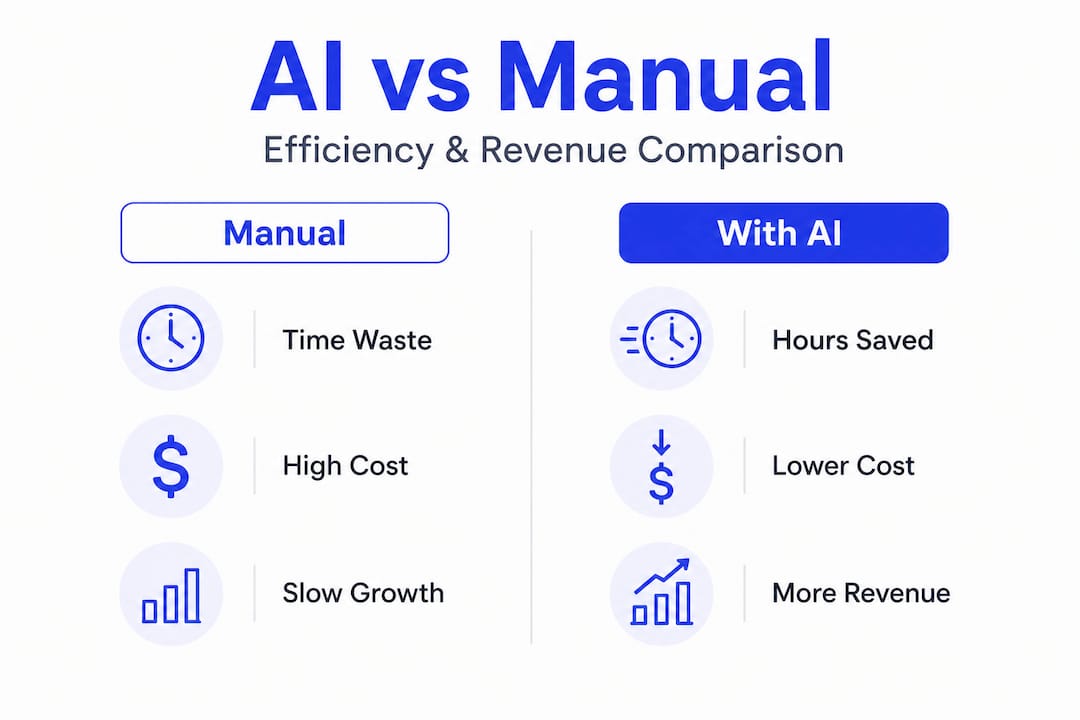
The pattern across all three sectors is identical. AI handles the volume. Professionals handle the judgment. Revenue follows.
How AI enhances operational efficiency in small practices
With sector-specific insights fresh, let’s see exactly how Miami’s small practices get the most from AI, from intake to daily workflows.
Small firms often assume AI is built for large organizations with dedicated IT departments. That assumption is wrong, and it’s costing them. AI tools for small law firms now automate marketing outreach, time tracking, client intake, and document drafting, allowing a three-attorney firm to operate with the efficiency of a twenty-person office without the payroll to match. Tools like Clio Duo integrate directly into existing legal workflows, so there’s no massive technology overhaul required.
Here’s a practical comparison of manual versus AI-enhanced workflows in a small Miami practice:
| Task | Manual time per week | AI-enhanced time per week | Time saved |
|---|---|---|---|
| Client intake and screening | 6 to 8 hours | 1 to 2 hours | 5 to 6 hours |
| Document drafting and review | 10 to 15 hours | 3 to 5 hours | 7 to 10 hours |
| Billing and time tracking | 4 to 6 hours | 1 hour | 3 to 5 hours |
| Appointment scheduling | 2 to 3 hours | Under 30 minutes | 1.5 to 2.5 hours |
That’s potentially 17 to 23 hours returned to a small practice every single week. For a solo practitioner or a two-person medical office, that kind of capacity shift is transformational. The operational efficiency gains measured across medical practices confirm this, showing an operational efficiency beta score of 0.525, meaning AI adoption has a statistically strong, measurable positive effect on practice performance.
Here’s a practical four-step approach for implementing AI in a small Miami practice:
- Identify your highest-volume repetitive tasks. Look at where your staff spends the most hours on work that doesn’t require professional judgment. Intake forms, appointment reminders, billing follow-ups, and basic document templates are common starting points.
- Select one tool to pilot first. Don’t try to automate everything at once. Pick one workflow, one tool, and measure results over 30 to 60 days. This builds internal confidence and surfaces real-world friction before you scale.
- Train your team on the tool’s purpose and limits. Staff adoption is the single biggest driver of whether AI delivers its promised returns. People need to understand what the tool does well and where it needs their oversight.
- Expand based on measured results. Once your first automation is running smoothly, use the data to justify and prioritize the next one. This is how sustainable, scalable implementation works.
Pro Tip: Start with client intake automation if you’re unsure where to begin. It’s visible, measurable, and immediately improves the client experience. Firms using workflow automation software report faster intake processing and fewer dropped leads within the first month. If you want to see how Miami-specific contexts change the calculus, our guide on automating workflow in Miami is worth reading alongside this. For a broader strategic view, the workflow automation guide for Miami professionals covers scaling considerations in detail.
Ethical, privacy, and verification challenges when using AI
Efficiency is impressive, but knowing and managing the risks is essential for responsible AI adoption in Miami’s professional sector.
AI is not infallible. In fact, treating it as though it is represents one of the most common and costly mistakes professionals make. Research on AI edge cases confirms that AI systems can produce hallucinations, meaning plausible but entirely fabricated outputs. In legal filings, medical records, and financial statements, a hallucination isn’t just an embarrassment. It’s a liability.
The core risks every Miami professional needs to understand before deploying AI include:
- Hallucinations and factual errors. AI language models can confidently produce incorrect information. Every AI-generated document, analysis, or recommendation in a professional context needs human review before it goes anywhere near a client or a court.
- Data privacy and confidentiality. Client data fed into third-party AI tools may be stored, processed, or used in ways that conflict with HIPAA, attorney-client privilege, or CPA confidentiality rules. Always vet the data handling practices of any AI vendor before using client information.
- Algorithmic bias. AI systems trained on historical data can perpetuate or amplify existing biases. In medical diagnosis support, this can affect patient outcomes. In legal research, it can skew case strategy. Our resource on AI bias in healthcare addresses this directly.
- Liability and professional responsibility. If an AI tool produces an error and a professional relies on it without adequate review, the professional is still responsible. No AI vendor absorbs your malpractice exposure.
- Staff attitude and adoption resistance. The same research notes that staff attitude significantly mediates operational efficiency gains. If your team doesn’t trust or understand the tool, the promised benefits won’t materialize. Change management is as important as the technology itself.
Pro Tip: Build a simple review checklist for any AI-generated output before it reaches a client or gets filed anywhere official. Pair every AI output with a human sign-off step. This isn’t just good practice. It’s professional protection. For a deeper understanding of AI and ML ethical challenges in regulated environments, the principles apply directly to Miami’s professional services context.
The role of AI in business innovation continues to evolve, and professionals who build verification habits now will be better positioned as tools become more capable and regulations tighten around AI use in licensed professions.
AI as a revenue growth driver for small businesses
Let’s close the loop. How do these efficiency gains translate into measurable revenue and growth for Miami’s small businesses?
The most important reframe is this: AI is not a cost center. It’s a revenue mechanism. Every hour your staff stops spending on administrative tasks is an hour that can be redirected toward billable work, business development, or improving client outcomes. That math compounds quickly.
Consider the numbers directly. An ambient scribe tool that saves a physician 2 hours per day across a 250-day working year returns 500 hours annually. At even a modest billing rate, that’s tens of thousands of dollars in recovered capacity, either in additional patient appointments or in time the physician can reinvest in practice growth, team leadership, or personal health.
Here are the specific revenue levers AI activates for Miami’s small practices:
- Faster client response times. AI-powered intake and triage tools mean new clients get responses in minutes rather than days. In competitive Miami markets, speed to response is often the deciding factor in whether a prospective client chooses your firm.
- More strategic billable time. When attorneys, physicians, and CPAs spend less time on documentation and admin, they have more capacity for high-value advisory work. That’s work clients pay more for and appreciate more.
- Reduced overhead without reduced capacity. Automating repetitive tasks means you can handle more client volume without proportional hiring. This is how small Miami firms start competing with larger ones.
- Improved client retention through better service. Faster responses, fewer errors, and more attentive professionals translate directly into stronger client relationships and higher retention rates.
Research on AI’s role in professional services makes a critical distinction: AI augments professionals rather than replacing them, shifting focus from routine competence to higher-order judgment. Small practices are currently lagging behind larger firms in adoption due to cost and IT infrastructure gaps, but that gap is closing. Miami firms that move now gain a window of competitive advantage that will narrow over the next two to three years. For professionals in financial services, our resource on AI in finance connects these efficiency gains to broader revenue outcomes.
Why Miami professionals shouldn’t fear AI—embrace strategic leverage
Here’s the perspective that most AI articles skip over: the professionals most at risk from AI are not the ones who adopt it. They’re the ones who refuse to.
We work with doctors, lawyers, and accountants across Miami every week. The resistance we hear most often is some version of “AI can’t replace my expertise.” That’s true. But it misunderstands the threat. AI won’t replace your expertise. A competitor who uses AI to serve three times as many clients with the same staff, faster response times, and lower overhead might not replace your expertise either. They’ll just take your clients.
The mindset shift that changes everything is moving from “AI as a tool” to “AI as a strategic asset.” A tool is something you pick up when it’s convenient. A strategic asset is something you build into your operations to create durable competitive advantage. Miami’s most forward-thinking small practices are already making this shift. They’re not waiting for AI to become perfect. They’re using it now, with appropriate human oversight, and building institutional knowledge about what works for their specific practice.
The other point worth stating plainly: small firms are closing the gap with large ones faster than most people realize. The cost of capable AI tools has dropped dramatically, and the IT complexity of implementation has decreased with it. You don’t need an enterprise IT department. You need the right partner and a clear-eyed implementation plan. Firms using faster workflow automation are already seeing measurable returns within the first quarter of implementation.
The professionals who thrive in the next five years won’t be the ones who are best at paperwork. They’ll be the ones who are best at judgment, relationships, and strategy, because AI handled everything else.
Ready to unlock efficiency and revenue with AI?
If what you’ve read here resonates with where your practice is today, you’re not alone. Many of Miami’s top legal, medical, and accounting professionals are at exactly this point: they understand the opportunity, but they need a clear, practical path to implementation that fits their budget, their compliance requirements, and their team.
We specialize in helping Miami’s independent professionals build the technology infrastructure to land bigger clients, scale without proportional hiring, and reclaim their time. From technology consulting for professionals to a detailed tech strategy for Miami revenue growth, we put all your technology in one partner. Start with our process optimization guide to see exactly where AI can move the needle in your practice, or reach out directly to schedule a consultation. The window for first-mover advantage is open. Let’s make sure your firm walks through it.
Frequently asked questions
What’s the biggest benefit of AI for small legal and medical firms?
AI saves hundreds of hours per month on paperwork and administrative tasks, freeing professionals to focus on judgment, strategy, and client relationships. The Miami-Dade Public Defender’s AI program across 75,000 cases annually is the clearest local proof of this at scale.
Can AI help with billing and client intake in Miami?
Yes, local tools already automate billing, document summarization, and intake workflows, improving both speed and accuracy significantly. Miami’s own AIdMD Technologies platform handles record summarization, billing optimization, and clinical issue flagging for physicians.
What are the main risks of AI in professional services?
AI can produce errors, biased outputs, and privacy vulnerabilities, making human verification and careful vendor selection essential. Research confirms that hallucinations and staff resistance are the two most common points of failure in professional AI deployments.
Does AI replace jobs in Miami accounting, legal, and medical sectors?
AI shifts work from administrative tasks to higher-order strategic work; it augments professionals rather than replacing them. Current analysis shows the transition is from routine competence to judgment-driven work, with small practices steadily closing the adoption gap with larger firms.