
Artificial intelligence is reshaping the way american financial professionals work, driving a revolution that touches every part of the industry. Over 60 percent of major financial institutions now rely on AI-driven tools for critical decision making. This changing landscape brings new challenges and opportunities as complex algorithms start to handle tasks once managed by human experts. Understanding how AI changes finance helps professionals stay ahead of trends, make better choices, and adapt to a world where smart technology sets the pace.
Table of Contents
- What Is AI in Finance? Core Concepts Defined
- Types of AI Applications in Financial Services
- How AI Transforms Accounting and Auditing
- AI for Risk Management and Regulatory Compliance
- Challenges, Risks, and Limitations of AI in Finance
Key Takeaways
| Point | Details |
|---|---|
| AI Revolutionizes Finance | Artificial intelligence enhances financial decision-making by performing complex tasks traditionally handled by human experts, thereby increasing efficiency. |
| Diverse Applications of AI | AI streamlines various operations such as fraud detection, risk management, and customer service, making processes faster and more accurate. |
| Importance for Professionals | Understanding AI is essential for accounting and finance professionals to stay competitive, as these technologies provide analytical advantages and improve client services. |
| Challenges of AI Adoption | Implementing AI comes with challenges, including data quality, ethical concerns, and regulatory compliance, which require careful management to ensure responsible use. |
What Is AI in Finance? Core Concepts Defined
Artificial intelligence is transforming financial services faster than most professionals realize. At its core, AI in finance represents a technological revolution that allows complex computational systems to perform tasks traditionally managed by human experts. From analyzing massive datasets to predicting market trends, AI brings unprecedented computational power to financial decision making.
The technological foundations of AI in finance include several critical components. Machine learning algorithms drive intelligence by enabling systems to learn from historical financial data, identifying patterns and generating predictive insights. These algorithms can process thousands of variables simultaneously, detecting subtle market signals that human analysts might easily overlook. Natural language processing allows AI systems to interpret financial reports, news articles, and regulatory documents with remarkable accuracy, extracting actionable intelligence in real time.
Practical applications of AI in financial services are incredibly diverse. Robotic process automation streamlines repetitive tasks like transaction processing, compliance reporting, and risk assessment. Predictive analytics help financial institutions make more informed lending decisions, detect potential fraud, and personalize customer experiences. Advanced AI models can even simulate complex economic scenarios, helping banks and investment firms develop more robust strategic planning.
For accounting professionals, understanding AI is no longer optional. The technological innovations emerging from AI research represent a fundamental shift in how financial work gets accomplished. Professionals who embrace these technologies can dramatically enhance their analytical capabilities, reduce manual workload, and provide more strategic insights to clients. The future of finance isn’t about replacing human expertise, but augmenting it with powerful computational tools that unlock new levels of efficiency and understanding.
Types of AI Applications in Financial Services
The landscape of AI applications in financial services is rapidly expanding, offering transformative solutions across multiple operational domains. Automation of daily activities stands out as a primary area where AI delivers substantial value, enabling financial institutions to streamline complex workflows and reduce manual intervention. From processing transactions to generating reports, these intelligent systems can complete tasks with unprecedented speed and accuracy.
Fraud detection represents another critical application where AI demonstrates remarkable capabilities. Advanced machine learning algorithms can analyze thousands of transactions in milliseconds, identifying suspicious patterns that might escape human detection. These systems learn continuously, adapting to emerging fraud techniques and providing real-time risk assessment. Beyond security, AI also revolutionizes customer service through intelligent chatbots and personalized recommendation engines that can understand individual financial needs and provide tailored guidance.
Risk management and portfolio construction are particularly fascinating domains where AI shines. Predictive models can simulate complex financial scenarios, helping financial professionals make more informed investment decisions. These sophisticated algorithms can process multiple economic indicators, market trends, and historical data to generate nuanced insights that traditional analytical methods might miss. Some cutting-edge AI systems can even generate synthetic financial data for stress testing and scenario planning, providing a robust framework for strategic decision-making.

For accounting professionals, understanding these AI applications isn’t just about technological curiosity. It’s about staying competitive in a rapidly evolving financial landscape. Emerging AI technologies are transforming how financial work gets accomplished, offering unprecedented opportunities for efficiency, accuracy, and strategic insight. The professionals who adapt and integrate these tools will be best positioned to deliver exceptional value to their clients, turning technological innovation into a powerful competitive advantage.
How AI Transforms Accounting and Auditing
Artificial intelligence is fundamentally reshaping the accounting and auditing landscape, introducing unprecedented levels of efficiency and accuracy. Predictive analytics now enable accounting professionals to move beyond traditional retrospective reporting, providing real-time insights and forward-looking financial assessments. These intelligent systems can analyze massive financial datasets, identifying complex patterns and potential anomalies that would traditionally require extensive manual review.
In the realm of auditing, AI-powered technologies are revolutionizing risk assessment and compliance processes. Advanced machine learning algorithms can instantly cross-reference financial transactions, detect potential fraud indicators, and flag unusual financial behaviors with remarkable precision. This automated approach dramatically reduces human error and enables auditors to focus on high-value strategic analysis rather than getting bogged down in repetitive verification tasks. The ability to process thousands of documents and transactions simultaneously means audits can be completed faster and with greater depth than ever before.
The integration of AI extends beyond simple number crunching. Explainable AI technologies are now capable of providing transparent rationales for financial recommendations and risk assessments. This means accounting professionals can leverage sophisticated computational insights while maintaining clear accountability and understanding of the underlying decision-making processes. Complex financial modeling, which once required days or weeks of manual calculation, can now be accomplished in minutes with unprecedented accuracy.
For modern accounting professionals, embracing AI is no longer optional but essential. Emerging AI techniques are transforming how financial work gets conducted, offering opportunities to deliver more strategic, data-driven insights to clients. Those who adapt quickly and integrate these intelligent tools will position themselves at the forefront of the accounting profession, turning technological innovation into a powerful competitive advantage that drives better financial decision-making.
AI for Risk Management and Regulatory Compliance
The landscape of financial risk management is undergoing a radical transformation through artificial intelligence, with sophisticated technologies providing unprecedented insights and predictive capabilities. Explainable AI models are revolutionizing how financial institutions approach complex risk assessment, offering transparent and interpretable methods for analyzing potential market vulnerabilities and regulatory challenges. These advanced systems can process vast amounts of historical and real-time data, identifying subtle risk patterns that traditional analytical approaches might completely miss.
Machine learning algorithms have become particularly powerful in credit risk assessment and compliance monitoring. Advanced credit scoring models can now analyze multiple data points simultaneously, creating more nuanced and accurate risk profiles than ever before. These intelligent systems go beyond traditional credit evaluation methods, incorporating non-traditional data sources and dynamic risk indicators that provide a more comprehensive view of financial risk. The result is a more dynamic, responsive approach to risk management that can adapt quickly to changing market conditions.
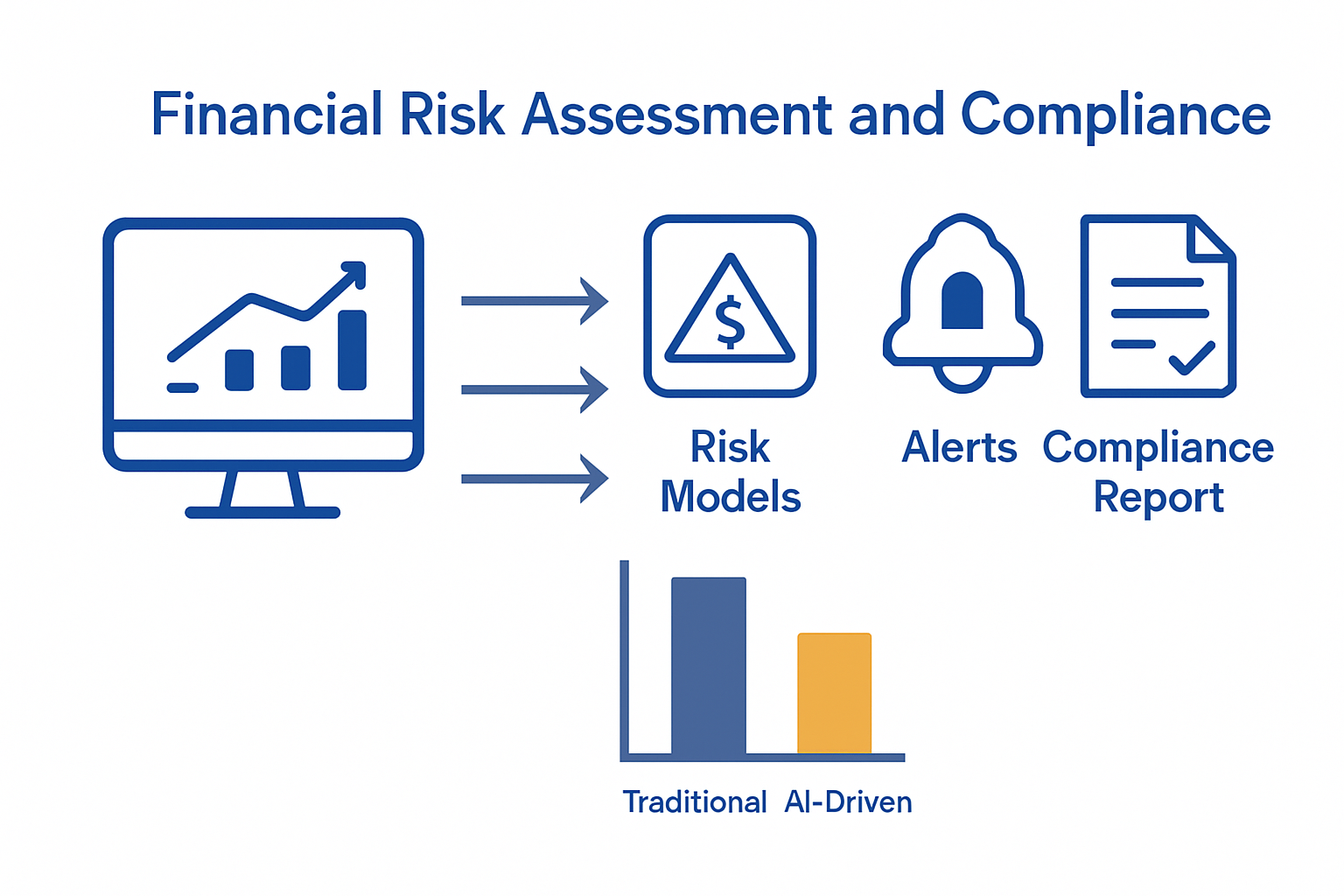
Regulatory compliance has historically been a complex and resource-intensive process, but AI is fundamentally changing that paradigm. Intelligent compliance monitoring systems can automatically track regulatory changes, assess organizational alignment, and flag potential compliance risks in real time. These systems reduce the manual effort required for compliance reporting and significantly minimize the potential for human error. By providing continuous, automated monitoring, AI enables financial institutions to maintain a proactive stance toward regulatory requirements, shifting from reactive to predictive compliance strategies.
For financial professionals, understanding and integrating AI into risk management represents more than a technological upgrade it’s a strategic imperative. Emerging AI techniques are creating opportunities to transform risk assessment from a defensive posture to a strategic advantage. Those who effectively leverage these intelligent technologies will be able to make more informed decisions, respond more quickly to potential risks, and ultimately create more resilient financial strategies that can navigate increasingly complex regulatory landscapes.
Challenges, Risks, and Limitations of AI in Finance
Despite the transformative potential of artificial intelligence, financial institutions face significant challenges in implementing these advanced technologies. Data quality and reliability emerge as critical concerns, with AI systems fundamentally dependent on the accuracy and comprehensiveness of their training datasets. Incomplete, biased, or outdated information can lead to flawed predictive models that generate misleading financial insights, potentially causing substantial strategic missteps for organizations relying on these technologies.
Ethical considerations represent another substantial hurdle in AI adoption. Algorithmic bias and transparency pose significant risks, particularly in areas like credit scoring and investment recommendations. AI systems can inadvertently perpetuate historical discrimination by replicating existing biases present in training data. This means financial institutions must implement rigorous monitoring and correction mechanisms to ensure fair and equitable decision-making processes that do not disadvantage specific demographic groups or perpetuate systemic inequalities.
Regulatory compliance presents an ongoing challenge for AI implementation in financial services. Complex legal frameworks require sophisticated AI systems to be not just powerful, but also fully explainable and auditable. Financial institutions must develop AI models that can provide clear, comprehensible rationales for their recommendations and decisions. This demand for transparency conflicts with the often opaque nature of advanced machine learning algorithms, creating a significant technical and regulatory challenge that requires continuous refinement and innovative approach to model development.
For financial professionals, understanding these limitations is crucial. Responsible AI adoption requires a balanced approach that acknowledges both the tremendous potential and inherent risks of artificial intelligence. Success will depend on maintaining human oversight, continuously validating AI models, and creating robust governance frameworks that prioritize ethical considerations, data integrity, and regulatory compliance. The most effective AI strategies will be those that view technology as a collaborative tool, augmenting human expertise rather than attempting to completely replace professional judgment.
Unlock the Power of AI with Expert IT Solutions for Accountants
The article highlights critical challenges accounting and finance professionals face when integrating AI technology such as ensuring data quality, maintaining ethical AI use, and achieving regulatory compliance. These pain points can cause costly errors, wasted time, and increased vulnerability to compliance risks. At Transform42, we specialize in aligning cutting-edge technology strategies with your business goals so you can harness AI’s transformative potential without the usual headaches. Our focus on ironclad compliance, nonstop reliability, and rapid response ensures your financial systems operate at peak performance.

Ready to overcome AI adoption challenges and elevate your finance operations with seamless technology? Explore our Technology Archives – Stratgetic IT Consultants For Accountants to learn how we streamline IT for Miami accounting firms. Gain peace of mind with 99.99 percent uptime and guaranteed 15-minute response times. Visit Transform42 now and start transforming your AI strategies into real business advantages while staying ahead in a complex regulatory landscape through our Grc Archives – Stratgetic IT Consultants For Accountants. Take control of your technology and compliance today.
Frequently Asked Questions
What is the role of AI in finance?
AI in finance involves using advanced computational systems to perform tasks traditionally managed by human experts, such as analyzing data, predicting market trends, and automating repetitive tasks.
How does AI enhance fraud detection in financial services?
AI enhances fraud detection by utilizing advanced machine learning algorithms that can analyze thousands of transactions in milliseconds, identifying suspicious patterns and continuously adapting to emerging fraud techniques.
What are the key applications of AI in accounting and auditing?
Key applications of AI in accounting and auditing include predictive analytics for real-time financial insights, risk assessment automation, compliance monitoring, and the ability to process large datasets for identifying anomalies.
What challenges do financial institutions face when implementing AI technologies?
Financial institutions face challenges such as data quality and reliability issues, ethical concerns regarding algorithmic bias, and the need for compliance with complex regulatory frameworks while ensuring AI systems are explainable and auditable.