Despite 82% of organizations recognizing Zero Trust as essential, only 17% have fully implemented it. This 65-point gap reveals a critical disconnect for Florida CPAs facing mounting cybersecurity threats and regulatory scrutiny. You understand the risks to client data, but misconceptions about complexity and cost may be holding you back. This article clarifies what Zero Trust really means and provides practical adoption steps tailored to financial professionals.
Table of Contents
- Understanding Zero Trust: Definition And Core Principles
- Why Zero Trust Matters For CPAs And Financial Consultants In Florida
- Common Misconceptions About Zero Trust Security
- Comparing Leading Zero Trust Frameworks And Technologies
- Practical Implementation Steps For Small And Mid-Sized CPA Firms
- Compliance Implications And Client Trust Enhancement
- Summary And Next Steps: Building Resilience With Zero Trust
- Frequently Asked Questions About Zero Trust Security For CPAs
Key Takeaways
| Point | Details |
|---|---|
| Continuous Verification | Zero Trust eliminates implicit trust by verifying every user and device interaction constantly. |
| Insider Threat Reduction | 56% of insider breaches stem from excessive privileges, which Zero Trust mitigates through least privilege access. |
| Phased Implementation | Small CPA firms can adopt Zero Trust gradually with leadership buy-in, starting with critical assets. |
| Compliance Alignment | Zero Trust frameworks support IRS and Florida cybersecurity requirements, strengthening client confidence. |
| Cultural Transformation | Zero Trust is not just technology but requires ongoing policy enforcement and user education. |
Understanding Zero Trust: Definition and Core Principles
You might think your network perimeter protects client data adequately. Zero Trust challenges that assumption completely. Zero Trust eliminates implicit trust regardless of network location, focusing on continuous verification of users, devices, and transactions.
This approach shifts security from perimeter defense to identity-centric continuous verification. Every access request gets scrutinized, whether originating inside or outside your firm’s network. You verify first, grant access second.
Core principles define how Zero Trust operates in practice:
- Least Privilege Access: Users receive only the minimum permissions needed for their specific tasks, nothing more.
- Microsegmentation: Network resources get divided into small zones, limiting lateral movement if a breach occurs.
- Continuous Monitoring: Real-time analytics track all activities, flagging anomalies immediately.
- Device Verification: Every device accessing your systems undergoes authentication and health checks.
- Identity Validation: Multi-factor authentication (MFA) confirms user identities beyond simple passwords.
The NIST SP 800-207 framework establishes authoritative architecture standards. This federal guideline provides CPA firms with clear implementation benchmarks.
For financial professionals handling sensitive tax returns and financial statements, these principles protect client data at every interaction point. Traditional perimeter security assumes trust once someone enters the network. Zero Trust assumes nothing and verifies everything.
Why Zero Trust Matters for CPAs and Financial Consultants in Florida
Data breaches devastate financial firms financially and reputationally. Breaches cost $4.35 million on average, a catastrophic expense for small to mid-sized CPA practices. You cannot afford this risk when handling client financial data.
Insider threats pose an equally serious danger. 56% of insider breaches result from excessive privileges. An employee with unnecessary system access becomes a liability, whether through malicious intent or simple negligence.
Florida CPAs face mounting regulatory pressure. The IRS increasingly expects sophisticated cybersecurity measures for firms handling tax data. State regulations demand protection of personal financial information. Falling short invites audits, penalties, and potential license issues.
Zero Trust directly addresses these challenges:
- Reduces Breach Costs: Limiting access and monitoring continuously stops threats before they escalate.
- Eliminates Over-Privileged Access: Least privilege policies ensure employees access only what they need.
- Supports Compliance: Meeting IRS Publication 4557 and Florida data protection statutes becomes straightforward.
- Protects Client Trust: Demonstrating advanced security measures differentiates your firm from competitors.
Implementing Zero Trust security frameworks positions your practice as a secure partner. Clients increasingly evaluate CPA firms on cybersecurity capabilities before engagement. You need this competitive advantage in 2026’s threat landscape.
Common Misconceptions About Zero Trust Security
The 65-point gap between recognizing Zero Trust’s importance and actual implementation stems from widespread misunderstandings. Let me clear up the myths preventing Florida CPA firms from moving forward.
Misconception 1: Zero Trust Is Just a Technology Purchase
Many believe buying specific security products equals Zero Trust adoption. Reality differs dramatically. Zero Trust requires cultural and organizational change, not just new software. Leadership commitment, policy updates, and continuous user education matter equally.
Misconception 2: Zero Trust Is Too Complex and Expensive for Small Firms
You might assume Zero Trust suits only large enterprises with unlimited IT budgets. Small CPA firms can adopt phased approaches, starting with critical systems and scaling gradually. Cloud-based solutions offer affordable entry points without massive infrastructure overhauls.
Misconception 3: Zero Trust Is a One-Time Implementation Project
Thinking Zero Trust ends after initial setup guarantees failure. This framework demands ongoing management, regular policy reviews, and continuous monitoring. Cyber threats evolve constantly, requiring adaptive security postures.
The adoption statistics reveal this challenge. Organizations understand Zero Trust’s strategic value but struggle with sustained implementation commitment.
Pro Tip: Begin with your most sensitive client data systems rather than attempting firm-wide deployment immediately. This focused approach builds expertise and demonstrates value before expanding governance across all assets.
Comparing Leading Zero Trust Frameworks and Technologies
Choosing the right framework prevents wasted effort and resources. Three major approaches suit CPA and financial consulting firms, each with distinct characteristics.
| Framework | Core Approach | Key Features | Best Suited For |
|---|---|---|---|
| Deloitte | Microsegmentation and real-time monitoring | Financial industry focus, continuous authentication, detailed analytics | Mid-sized firms with complex client data flows |
| NSA | Government phased implementation | Discovery phase, asset prioritization, structured rollout | Firms seeking methodical, security-first approach |
| Microsoft | Leadership-driven integrated verification | Cross-platform governance, cloud integration, user education emphasis | Small to mid-sized firms using Microsoft ecosystem |
Deloitte’s framework emphasizes microsegmentation, dividing networks into isolated zones. Real-time monitoring tracks every transaction across these segments. Financial services firms benefit from industry-specific controls addressing regulatory requirements.
The NSA approach starts with comprehensive asset discovery. You map every device, user, and data flow before implementing controls. This government-tested methodology prioritizes critical assets first, reducing immediate risks while planning broader adoption.
Microsoft’s framework centers on leadership buy-in and cross-functional coordination. Integrated verification across identity, devices, applications, and data creates comprehensive protection. Cloud-native tools simplify deployment for firms already using Microsoft 365 or Azure.
Small CPA firms often find Microsoft’s approach most accessible, given existing technology investments. Mid-sized practices handling complex financial instruments might prefer Deloitte’s granular controls. Your choice depends on current infrastructure, staff expertise, and specific compliance requirements.
Practical Implementation Steps for Small and Mid-Sized CPA Firms
Theory means nothing without execution. Follow these concrete steps to adopt Zero Trust effectively in your practice.
Step 1: Secure Executive and Cross-Team Commitment
Leadership buy-in proves critical for Zero Trust success. Schedule meetings with firm partners explaining cybersecurity risks, breach costs, and competitive advantages. Allocate budget and staff time upfront. Assign a project champion responsible for coordinating implementation.
Step 2: Conduct Asset Discovery and Data Flow Mapping
You cannot protect what you do not know exists. Inventory every device, application, and data repository. Map how client information flows through your systems from intake through tax filing. Identify your most sensitive assets requiring immediate protection.

Step 3: Implement Identity and Device Verification Controls
Deploy multi-factor authentication across all systems immediately. This single step blocks most unauthorized access attempts. Add device health checks ensuring only compliant, updated devices access firm resources. Cloud-based identity management platforms simplify this process.
Step 4: Apply Least Privilege Access Policies
Review every employee’s system permissions. Strip unnecessary access ruthlessly. A junior associate preparing 1040s does not need access to partnership tax returns. Implement microsegmentation separating client data into isolated zones based on engagement teams.
Step 5: Conduct Ongoing User Training and Policy Updates
Schedule quarterly security awareness training covering phishing, social engineering, and safe data handling. Run simulated phishing campaigns measuring employee vigilance. Update policies as threats evolve and regulations change.
Pro Tip: Regular security training reduces phishing success rates by over 50%, creating your strongest defense against social engineering attacks that bypass technical controls.
Adapt implementation speed to your firm’s size and complexity. A three-person practice might complete these steps in weeks. A 50-person firm needs months for thorough rollout. Prioritize cybersecurity best practices that protect client data immediately while building comprehensive frameworks.
Compliance Implications and Client Trust Enhancement
Zero Trust adoption delivers measurable compliance and business advantages beyond security improvements.
Federal contracts and IRS guidance increasingly reference Zero Trust principles. Firms seeking to serve government clients or handle federal tax matters face mounting expectations for sophisticated cybersecurity. Zero Trust frameworks align with these evolving requirements, positioning your practice for expanded opportunities.
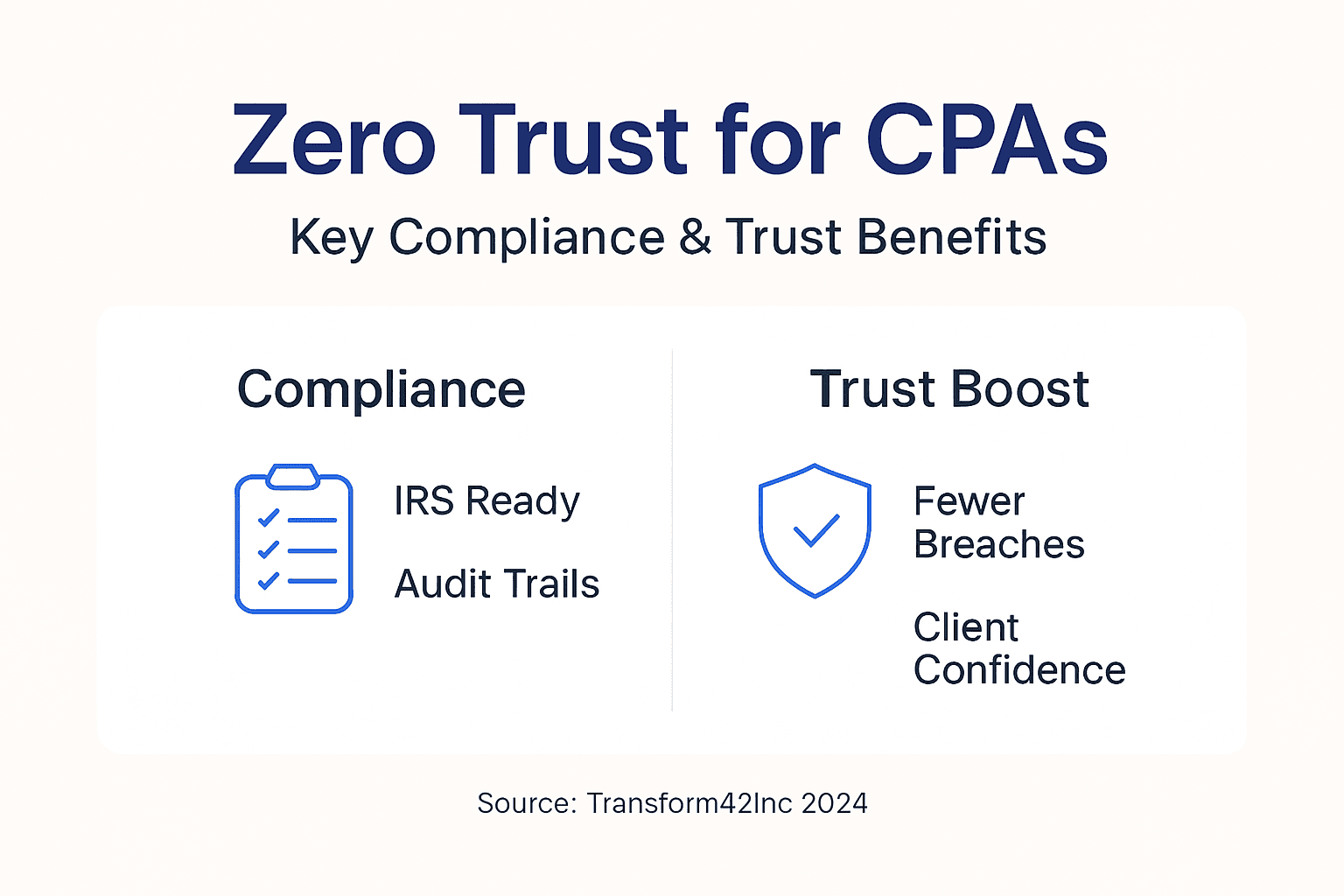
Compliance audits become less stressful when Zero Trust controls exist. You demonstrate continuous monitoring, least privilege access, and comprehensive logging. These capabilities satisfy auditor requirements for data protection and privacy controls. Audit preparation time decreases while pass rates improve.
Client confidence grows when you articulate your security posture. Prospects evaluating CPA firms ask pointed questions about data protection. Explaining your Zero Trust implementation differentiates you from competitors relying on outdated perimeter security. You win engagements based on trust and capability.
Key compliance and business benefits include:
- Reduced Penalty Risk: Strong security controls minimize regulatory violation likelihood and associated fines.
- Expanded Service Opportunities: Meeting federal security standards opens doors to government and large corporate clients.
- Competitive Differentiation: Advanced cybersecurity becomes a market advantage in client acquisition.
- Insurance Premium Reductions: Some cyber insurance providers offer discounts for Zero Trust implementations.
Regulatory expectations will only intensify in 2026 and beyond. Early adopters gain advantages while competitors scramble to catch up. Your security posture directly impacts your firm’s growth trajectory and client retention.
Summary and Next Steps: Building Resilience with Zero Trust
Zero Trust fundamentally changes how Florida CPA firms protect sensitive client financial information. You have learned the core principles, understood common misconceptions, compared leading frameworks, and reviewed practical implementation steps.
Key benefits justify the implementation effort:
- Comprehensive Data Protection: Continuous verification stops threats before they compromise client information.
- Insider Threat Mitigation: Least privilege access and microsegmentation reduce risks from over-privileged employees.
- Manageable Implementation: Phased approaches with leadership backing make adoption feasible for small firms.
- Regulatory Alignment: Zero Trust frameworks help meet IRS and Florida cybersecurity requirements.
- Market Advantage: Advanced security capabilities differentiate your practice and build client trust.
The 65-point gap between recognizing Zero Trust’s importance and achieving full implementation represents opportunity. Firms acting now gain competitive advantages while others hesitate. Start with critical assets, secure leadership commitment, and build your framework incrementally.
2026 brings evolving cyber threats and tightening regulations. Your clients expect sophisticated data protection. Zero Trust provides the resilient security posture required for success in today’s environment.
Secure Your CPA Firm with Expert Zero Trust Support
Implementing Zero Trust requires specialized expertise you might not have in-house. Transform42Inc helps Florida CPAs adopt comprehensive cybersecurity frameworks tailored to firm size and compliance requirements.
We understand the unique challenges facing financial professionals. Our technology solutions for accountants combine Zero Trust principles with practical implementation roadmaps. Whether you run a solo practice or manage a multi-partner firm, we design security architectures matching your needs and budget.
Our digital transformation services extend beyond security to comprehensive IT strategy. We help you build capabilities clients expect while maintaining compliance and protecting sensitive data. You focus on serving clients while we handle the technical complexity.
Review our detailed Zero Trust security guide for additional insights. Then contact us for a consultation. We will assess your current security posture, identify gaps, and propose a phased implementation plan.
Pro Tip: Partnering with cybersecurity specialists accelerates Zero Trust adoption and ensures compliance readiness, letting you serve clients with confidence.
Frequently Asked Questions About Zero Trust Security for CPAs
What is the first step small CPA firms should take to implement Zero Trust?
Start by securing leadership commitment and conducting comprehensive asset discovery. Map your client data flows and identify your most sensitive information requiring immediate protection. Deploy multi-factor authentication across all systems as your first technical control.
How does Zero Trust help with regulatory compliance for CPAs?
Zero Trust frameworks align with IRS cybersecurity expectations and Florida data protection requirements through continuous monitoring, least privilege access, and comprehensive audit logging. These controls satisfy regulatory mandates while simplifying compliance audits and reducing penalty risks.
Can Zero Trust be affordable for small firms with limited IT budgets?
Yes, through phased implementation starting with critical systems and using cloud-based solutions. You do not need massive infrastructure investments upfront. Begin with identity verification and access controls, then expand gradually as budget and expertise grow.
How often should Zero Trust policies and training be updated?
Conduct quarterly security awareness training and policy reviews at minimum. Update policies immediately when regulations change or new threats emerge. Continuous monitoring and adaptive security postures ensure your framework evolves with the threat landscape.
Does Zero Trust protect against insider threats?
Absolutely. Least privilege access policies ensure employees access only necessary systems, eliminating over-privileged accounts that enable 56% of insider breaches. Microsegmentation limits lateral movement, while continuous monitoring detects anomalous behavior immediately.