
Managing vendors without a clear process exposes Miami accounting firms to compliance violations, contract disputes, and operational inefficiencies that can derail client relationships and invite regulatory penalties. Miami-Dade County’s procurement framework demands strict adherence to federal, state, and local regulations, making vendor management a critical competency for accountants and financial consultants. This guide walks you through the essential vendor management process steps tailored to Miami-Dade’s regulatory environment, helping you enhance compliance, streamline operations, and deliver superior client value. You’ll learn preparation strategies, execution tactics, verification methods, and continuous improvement practices that transform vendor management from a liability into a strategic advantage.
Table of Contents
- Understanding Miami-Dade Procurement Compliance Requirements
- Preparation: Gathering Requirements And Selecting Vendors
- Execution: Managing Vendor Relationships And Contracts Effectively
- Verification And Continuous Improvement Of Vendor Processes
- Enhance Your Vendor Management With Strategic Technology Solutions
- Frequently Asked Questions
Key takeaways
| Point | Details |
|---|---|
| Compliance framework | Miami-Dade vendor management requires adherence to county ordinances, state statutes, and federal regulations with strict policy hierarchy |
| Strategic procurement roles | The Strategic Procurement Department and Chief Procurement Officer oversee policy updates and administrative guidance for vendor processes |
| Step-by-step process | Following structured preparation, execution, and verification steps reduces compliance risks and improves operational efficiency |
| Continuous adaptation | Vendor management practices must evolve with regulatory changes to maintain compliance and competitive advantage |
Understanding Miami-Dade procurement compliance requirements
Before you can effectively manage vendors, you need to understand the legal framework governing procurement in Miami-Dade County. The compliance hierarchy establishes clear precedence: federal regulations supersede state statutes, which in turn supersede county ordinances, administrative orders, and resolutions. This legal hierarchy governs procurement policies and determines how conflicts between different regulatory levels get resolved. When federal law conflicts with county policy, federal law wins.
For Miami accountants, this hierarchy means you must track compliance requirements across multiple jurisdictions simultaneously. Federal regulations like the Federal Acquisition Regulation apply when clients receive federal funding. Florida state statutes govern general procurement practices statewide. Miami-Dade County ordinances add local requirements specific to county operations and contractors. Missing any layer creates compliance gaps that expose your firm and clients to audit findings, contract disputes, and financial penalties.
The Strategic Procurement Department and Chief Procurement Officer serve as the primary authorities for interpreting and updating procurement guidelines administratively. They cannot change policies established by the Board of County Commissioners, but they regularly update best practices, clarify implementation procedures, and provide guidance on emerging compliance issues. Accountants should monitor these updates quarterly to ensure vendor management practices remain current.
Key compliance documents you need to reference include the Miami-Dade County Procurement Guidance Document, Administrative Orders from the Mayor’s office, relevant Board resolutions, and applicable state statutes. These documents outline vendor qualification requirements, contract approval thresholds, competitive bidding rules, and documentation standards. Understanding vendor management importance helps you prioritize which compliance areas demand immediate attention versus those requiring periodic review.
Pro Tip: Create a compliance calendar that tracks update cycles for federal, state, and county procurement regulations. Set quarterly reviews to catch policy changes before they impact active vendor relationships.
Preparation: Gathering requirements and selecting vendors
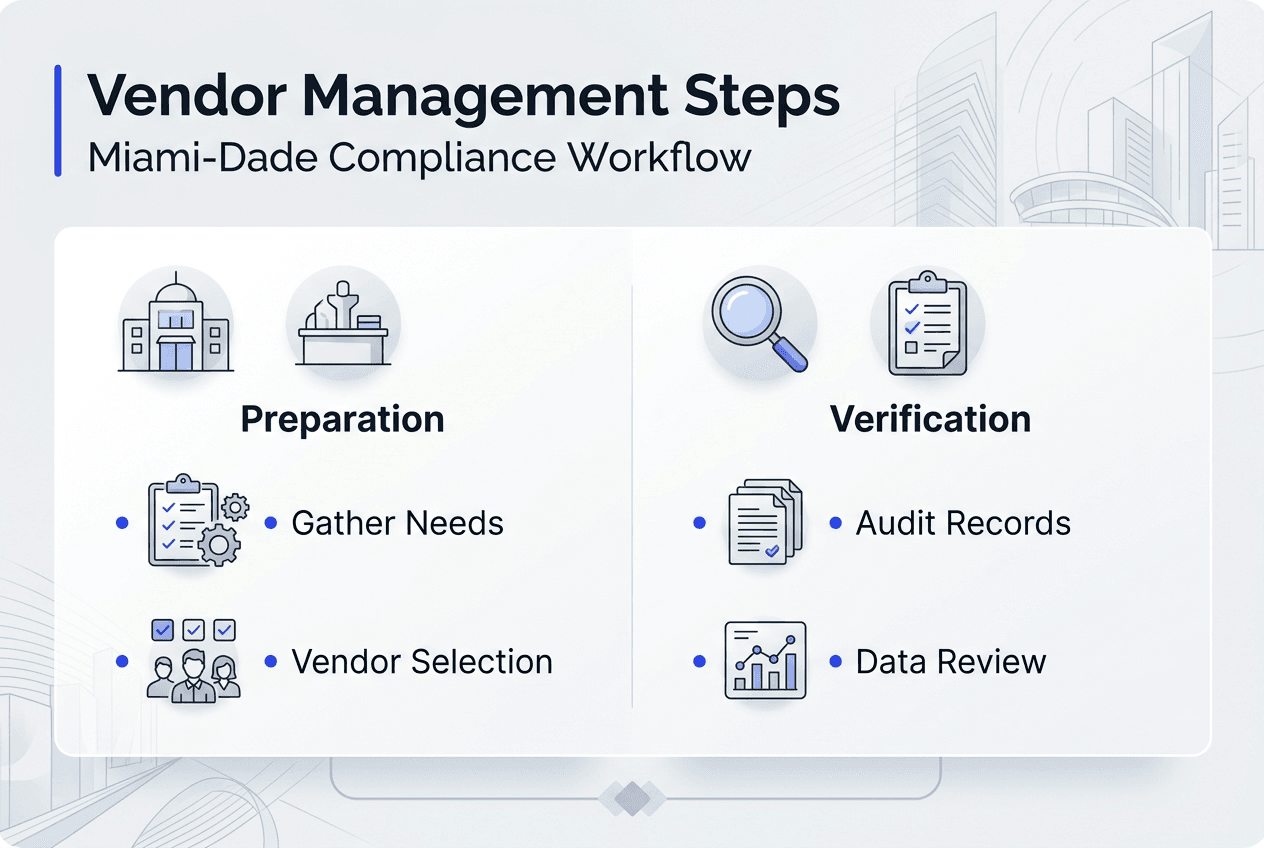
Effective vendor management starts long before you sign a contract. The preparation phase determines whether your vendor relationships will support compliance and efficiency or create ongoing problems. Begin by documenting specific requirements for each vendor engagement: what services or products do you need, what compliance standards must vendors meet, what performance metrics will you track, and what contract terms protect your interests and client obligations.
When preparing requests for proposals or requests for quotes, follow Miami-Dade guidelines that ensure competitive fairness and transparency. Your RFP should clearly state evaluation criteria, required qualifications, compliance certifications needed, submission deadlines, and contract terms. Vague requirements lead to unsuitable vendor responses and wasted evaluation time. Specific requirements attract qualified vendors who understand your compliance needs and can deliver accordingly.
The Strategic Procurement Department oversees policy implementation and can provide guidance on RFP structure, evaluation processes, and vendor qualification standards. Engaging them early prevents procedural errors that could invalidate your vendor selection process. They can also clarify which procurement methods apply based on contract value thresholds and service categories.
Your vendor evaluation process should include these steps:
- Screen vendors for basic qualifications including licenses, insurance, and compliance certifications required by Miami-Dade regulations
- Evaluate technical capabilities against your documented requirements using objective scoring criteria
- Assess financial stability through credit checks, reference verification, and financial statement review
- Review past performance with similar clients, focusing on compliance track records and service quality
- Conduct interviews or presentations to evaluate communication skills and cultural fit with your firm’s values
- Compare pricing structures ensuring you understand total cost of ownership beyond initial contract value
Document every evaluation step with written justifications for selections and rejections. This documentation protects you during audits and demonstrates compliance with competitive selection requirements. It also provides valuable reference material when you need to repeat the vendor selection process for similar engagements.
Pro Tip: Common pitfalls include accepting vendor-provided compliance certifications without verification, skipping reference checks to save time, and evaluating price alone without considering total value. Always verify certifications directly with issuing authorities and conduct thorough due diligence even when timelines feel tight. Partnering with business transformation consulting experts can streamline this preparation phase while maintaining rigor.
Execution: Managing vendor relationships and contracts effectively
Once you’ve selected vendors, execution determines whether those relationships deliver promised value while maintaining compliance. Contract management forms the foundation of effective execution. Your contracts must clearly specify deliverables, performance standards, compliance requirements, payment terms, termination conditions, and dispute resolution procedures. Ambiguous contracts create conflicts that waste time and money while exposing you to compliance risks.

Miami-Dade guidelines emphasize written documentation for all material vendor communications and decisions. Verbal agreements and informal changes create audit problems and contract disputes. Establish a communication cadence that includes regular status meetings, written progress reports, and formal change request procedures. Document decisions, approvals, and issue resolutions in writing, storing these records in organized systems that support easy retrieval during audits or disputes.
Tracking vendor performance requires defining specific, measurable metrics aligned to your contract terms and compliance requirements. These metrics might include:
- Service level agreement compliance rates measuring whether vendors meet response time and resolution commitments
- Quality metrics tracking error rates, rework requirements, or client satisfaction scores
- Compliance metrics monitoring whether vendors maintain required certifications, submit mandated reports, and follow prescribed procedures
- Financial metrics comparing actual costs against budgeted amounts and tracking invoice accuracy
Create a performance dashboard that consolidates these metrics, making it easy to spot problems early and take corrective action before minor issues become major failures. Share performance data with vendors regularly, using it as a basis for constructive feedback and continuous improvement discussions.
| Metric Category | Example Measures | Review Frequency |
|---|---|---|
| Service delivery | Response time, completion rate, availability | Weekly |
| Quality | Error rate, client satisfaction, rework percentage | Monthly |
| Compliance | Certification status, audit findings, policy adherence | Quarterly |
| Financial | Budget variance, invoice accuracy, cost trends | Monthly |
As procurement practices evolve continuously, your vendor management processes must adapt accordingly. The procurement manual functions as a living document, updated regularly to reflect new regulations, best practices, and lessons learned from past procurements. Subscribe to update notifications from the Strategic Procurement Department and schedule quarterly reviews of vendor management procedures to incorporate new guidance.
Pro Tip: Automate compliance tracking using technology platforms that monitor vendor certifications, track contract milestones, and alert you to upcoming renewals or required actions. Automation reduces manual effort while improving accuracy and timeliness. Explore agile accounting practices that integrate vendor management automation into your broader operational workflows.
Verification and continuous improvement of vendor processes
Verification ensures your vendor management activities actually achieve intended compliance and efficiency outcomes. Conduct periodic vendor management audits that examine whether you’re following established procedures, maintaining required documentation, achieving performance targets, and complying with applicable regulations. These audits should review contract files, performance records, communication logs, and compliance certifications to identify gaps or weaknesses.
Your audit process should answer critical questions: Are vendors maintaining required licenses and certifications? Do contract files contain all required documentation? Are you tracking and addressing performance issues promptly? Do vendor relationships comply with conflict of interest policies? Are you following competitive selection requirements consistently? Document audit findings and create action plans to address identified deficiencies.
Capturing and analyzing vendor performance data enables evidence-based improvements to your vendor management processes. Look for patterns in vendor performance problems, contract disputes, or compliance issues. These patterns often reveal systemic weaknesses in your selection criteria, contract terms, or oversight procedures. For example, if multiple vendors struggle with the same contract requirement, the requirement itself may be unclear or unrealistic.
Continuous improvement cycles transform vendor management from a static compliance exercise into a dynamic capability that strengthens over time. After each vendor engagement, conduct a retrospective that captures lessons learned, identifies improvement opportunities, and updates procedures accordingly. Share these lessons across your firm so everyone benefits from accumulated experience.
| Approach | Characteristics | Outcomes |
|---|---|---|
| Reactive vendor management | Addresses problems after they occur, minimal documentation, informal processes | Higher compliance risks, frequent disputes, inefficient operations |
| Proactive vendor management | Prevents problems through planning, comprehensive documentation, structured processes | Lower compliance risks, fewer disputes, improved efficiency |
Implement ongoing process refinement through these steps:
- Collect feedback from internal stakeholders who interact with vendors, capturing their observations about what works well and what creates friction
- Analyze performance data to identify trends, comparing actual results against targets and investigating significant variances
- Benchmark your vendor management practices against industry standards and peer firms to identify improvement opportunities
- Pilot process improvements on a small scale before rolling them out broadly, measuring impact and refining based on results
- Update documented procedures to reflect proven improvements, training staff on changes and monitoring adoption
Remember that only the Board of County Commissioners can change procurement policies, while the Strategic Procurement Department updates administrative guidelines. This distinction matters when you identify improvement opportunities that require policy changes versus those you can implement through updated procedures. Focus your improvement efforts on areas within your control while advocating for policy changes when systemic barriers impede compliance or efficiency.
Integrating vendor management improvements into your digital transformation workflow creates compounding benefits. As you digitize vendor records, automate compliance tracking, and implement performance dashboards, you reduce manual effort while improving accuracy and visibility. These technology enablers make continuous improvement easier by providing better data and freeing time for strategic activities.
Enhance your vendor management with strategic technology solutions
Mastering vendor management process steps requires more than knowledge. You need the right technology infrastructure and strategic support to execute consistently at scale. Transform42 specializes in helping Miami accountants and financial consultants build technology capabilities that transform vendor management from a compliance burden into a competitive advantage. Our technology solutions for accountants automate routine vendor management tasks, provide real-time compliance monitoring, and deliver actionable insights that improve decision making.
We understand the unique challenges Miami accounting firms face: complex regulatory requirements, growing client expectations, and pressure to scale without proportional hiring. Our digital transformation services help you implement vendor management systems that integrate seamlessly with your existing workflows while positioning you for future growth. When you’re ready to move beyond manual spreadsheets and reactive problem solving, process automation workflow solutions provide the foundation for scalable, compliant vendor management that supports your firm’s growth ambitions.
Frequently asked questions
What are the key Miami-Dade regulations impacting vendor management?
Miami-Dade vendor management operates under a hierarchy where federal regulations supersede state statutes, which supersede county ordinances, administrative orders, and resolutions. County ordinances establish procurement policies that only the Board of County Commissioners can change, while the Strategic Procurement Department and Chief Procurement Officer update administrative guidelines and best practices. Key regulations cover competitive selection requirements, contract approval thresholds, vendor qualification standards, and documentation requirements that accountants must follow when managing vendor relationships.
How do procurement authorities influence vendor management policies?
The Board of County Commissioners holds exclusive authority to establish or modify procurement policies through ordinances and resolutions. The Strategic Procurement Department Director and Chief Procurement Officer cannot change these policies but update administrative guidelines, clarify implementation procedures, and provide best practice guidance within the established policy framework. This separation ensures policy stability while allowing operational flexibility as procurement practices evolve.
What criteria should accountants use for ongoing vendor compliance evaluation?
Ongoing vendor compliance evaluation should verify that vendors maintain required licenses, certifications, and insurance coverage throughout the contract term. Monitor vendor adherence to contract terms including service levels, quality standards, and reporting requirements. Track compliance with applicable federal, state, and local regulations relevant to the services provided. Review vendor financial stability periodically to ensure they can fulfill contract obligations, and document all compliance checks to support audit requirements.
How can digital tools support vendor management compliance monitoring?
Digital tools automate compliance tracking by monitoring vendor certification expiration dates, contract milestones, and required reporting deadlines with automatic alerts for upcoming actions. Performance dashboards consolidate metrics across multiple vendors, making it easy to identify compliance issues or performance problems early. Document management systems organize contract files, communications, and compliance records in searchable repositories that support efficient audits. Analytics capabilities identify trends and patterns that inform process improvements and risk mitigation strategies.
What process ensures accountants stay current with procurement manual revisions?
Subscribe to update notifications from the Miami-Dade Strategic Procurement Department to receive alerts when the procurement manual or related guidance documents are revised. Schedule quarterly reviews of the procurement manual and related administrative orders to identify changes that impact your vendor management procedures. Participate in procurement training sessions or webinars offered by the county to understand new requirements and implementation expectations. Document procedure updates internally and train staff on changes to ensure consistent application across your firm.
How does proactive vendor management reduce compliance risks compared to reactive approaches?
Proactive vendor management prevents compliance problems through structured processes, comprehensive documentation, and regular monitoring that catches issues early when they’re easier to resolve. Reactive approaches address problems only after they occur, often resulting in compliance violations, contract disputes, and operational disruptions that damage client relationships. Proactive management invests time upfront in vendor selection, contract clarity, and performance tracking, yielding lower long-term costs and risks compared to reactive firefighting that consumes resources without building lasting capabilities.