TL;DR:
- Smart governance blends technology, institutions, and client participation to enhance business operations.
- It leads to efficiency gains of 20-30 percent and improves transparency and client trust.
- Challenges include data privacy, digital exclusion, and integration complexities.
Many Miami doctors, lawyers, and accountants assume smart governance is simply about automating paperwork or moving files to the cloud. That assumption leaves serious revenue and efficiency gains on the table. Smart governance is actually a strategic blend of intelligent technology, institutional frameworks, and active client participation that reshapes how professional practices operate and grow. For professionals in Miami’s competitive, regulation-heavy environment, this distinction matters enormously. This guide breaks down what smart governance really means, how it works in practice, what measurable results it delivers, and where the real challenges lie so your firm can move forward with clarity and confidence.
Table of Contents
- What is smart governance? A plain-language definition
- Core methodologies: How smart governance works in practice
- Benchmarks and real-world results: What smart governance achieves
- Nuances and challenges: What most experts miss about smart governance
- A Miami perspective: Applying smart governance for local professionals
- Transform your practice with smart governance solutions
- Frequently asked questions
Key Takeaways
| Point | Details |
|---|---|
| Comprehensive definition | Smart governance blends technology, participation, and data for operational and client-centric improvements. |
| Tangible efficiency gains | Professionals leveraging smart governance can realize 20-30% improvements in workflow and engagement. |
| Local adaptation is key | Hybrid and federated models work best for Miami’s unique mix of regulations and sector needs. |
| Ethics and privacy matter | Address ethical AI use and privacy risks to build trust and ensure compliance. |
What is smart governance? A plain-language definition
Smart governance gets misquoted constantly. People use it interchangeably with “digital transformation” or “e-government,” but those terms describe something narrower. Understanding the difference is the first step toward using it strategically.
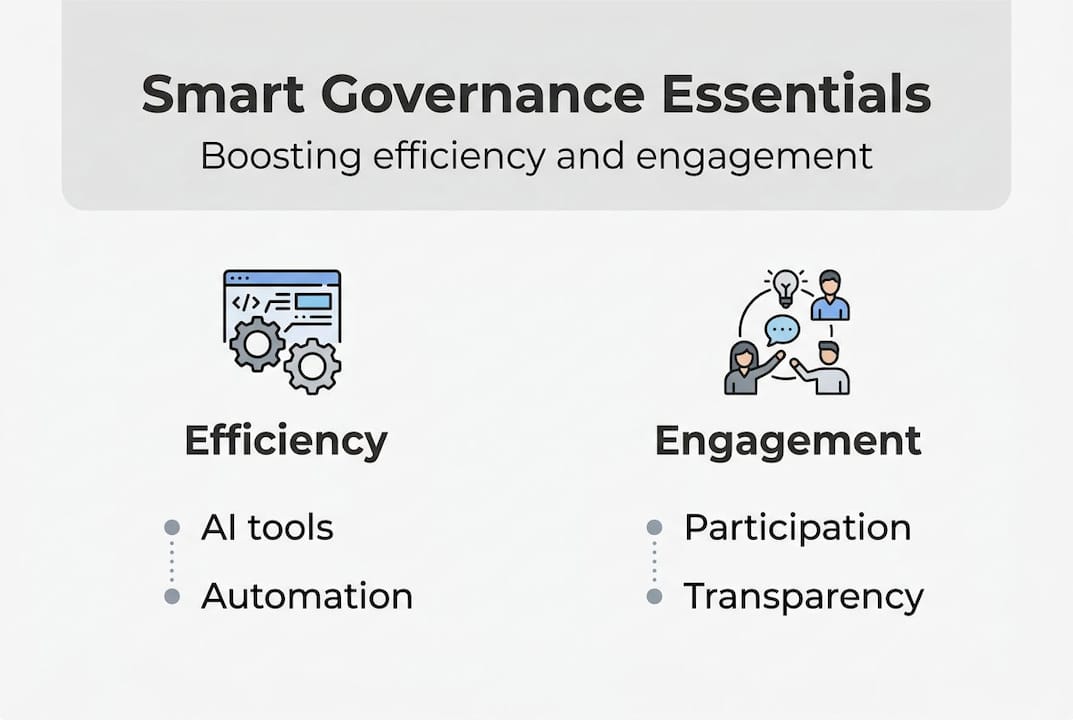
At its core, smart governance is a multidimensional paradigm that integrates technology, institutions, and civic participation to enhance administration through transparency, collaboration, and client engagement. For a Miami law firm or medical practice, that means your governance model should do three things simultaneously: use intelligent tools, align with regulatory institutions, and actively involve your clients in decisions that affect them.
“Smart governance is not a product you buy. It is a continuous practice that combines the right technology with the right people processes.”
Here is where the contrast with digital governance becomes critical. Smart emphasizes intelligent technologies for efficiency and adaptability, while digital governance focuses primarily on digitizing existing services. Think of digital governance as scanning paper charts into a system. Smart governance would use those digitized records to flag patterns, predict patient needs, and prompt proactive outreach, all while keeping the patient informed and involved.
For accountants, lawyers, and physicians in Miami, four drivers make smart governance especially relevant right now:
- Transparency: Clients expect real-time visibility into their cases, accounts, or health plans.
- Collaboration: Decisions made with clients, not just for them, build loyalty and reduce disputes.
- Data-driven decision-making: Evidence replaces guesswork in billing, compliance, and care planning.
- Continuous learning: The model adapts as regulations, technology, and client expectations shift.
Exploring AI in business strategies can help you see how these drivers translate into daily practice operations. Smart governance is not a one-time project. It is a living framework that evolves with your firm.
Core methodologies: How smart governance works in practice
Knowing the definition is useful. Knowing how to implement it is what actually moves the needle for your practice.
Key mechanics include AI integration for predictive analytics, big data for evidence-based decision-making, open data platforms, participatory frameworks, and hybrid models. Each of these plays a specific role in a professional services environment.
Here is how a smart governance initiative typically rolls out for a Miami practice:
- Assess your current state. Map existing workflows, data sources, and client touchpoints. Identify where decisions are slow, opaque, or error-prone.
- Select sector-specific tools. A medical practice needs HIPAA-compliant AI platforms. A law firm needs secure client portals with audit trails. An accounting firm needs ERP integration with real-time dashboards.
- Build participatory frameworks. Create structured ways for clients to provide input, review decisions, and flag concerns. Client advisory boards, digital feedback loops, and consent workflows all qualify.
- Connect to central standards. Once local tools are running, integrate them with broader compliance and reporting frameworks relevant to Florida regulations.
- Monitor, measure, and adapt. Use analytics to track outcomes and refine the model continuously.
| Approach | Focus | Best for |
|---|---|---|
| Technology-centric | Automation and AI efficiency | High-volume transactional work |
| Socio-technical | Participation and collaboration | Complex advisory relationships |
| Federated model | Local autonomy plus shared standards | Multi-location or specialty practices |
| Centralized model | Uniform control and consistency | Single-location compliance-heavy firms |
Understanding the role of AI in consulting helps clarify which approach fits your practice type. Hybrid and federated models tend to work best for Miami professionals because they allow each specialty to adapt tools locally while staying aligned with state and federal compliance standards. Governance model research from the UK government also supports the case for flexible, federated structures in professional services.

Pro Tip: Start with one high-friction workflow, such as client intake or billing reconciliation, and apply a smart governance layer there first. Prove the value before scaling across the practice.
Benchmarks and real-world results: What smart governance achieves
Results matter more than theory. So what does the data actually show?
The Smart Governance Index for 296 Chinese cities tracked from 2017 to 2023 reveals significant variation in outcomes, with high-performing cities showing measurable gains in public service efficiency and citizen satisfaction. A separate study of Spanish cities links e-government adoption and transparency directly to stronger employment performance. Perhaps most striking, the eGovernment Benchmark 2024 reports an EU average user centricity score of 93 out of 100 for regions with mature smart governance systems.
For Miami professionals, these benchmarks translate into real practice gains. Firms that adopt AI in digital transformation strategies consistently report 20 to 30 percent efficiency improvements in administrative and compliance workflows.
Here is what those gains look like across sectors:
- Medical practices: Faster prior authorization, reduced billing errors, and proactive patient outreach through predictive scheduling.
- Law firms: Automated document review, real-time case status portals for clients, and AI-assisted contract analysis.
- Accounting firms: Real-time financial dashboards, automated tax compliance alerts, and client self-service portals that reduce back-and-forth by a significant margin.
| Region or sector | Key outcome | Metric |
|---|---|---|
| EU eGovernment 2024 | User centricity | 93/100 |
| Spanish cities study | Employment performance | Linked to e-gov and transparency |
| Chinese SGI cities | Efficiency variation | Tracked across 296 cities, 2017 to 2023 |
| Miami professional services | Workflow efficiency | 20 to 30% projected gain |
These eGovernment results confirm that smart governance is not experimental. It is a proven operational strategy with documented returns. The question for your practice is not whether it works. It is how quickly you can capture those gains.
Nuances and challenges: What most experts miss about smart governance
The benefits are real, but so are the risks. And in professions where a single compliance failure can cost a license or a lawsuit, you need to go in with clear eyes.
Edge cases include data privacy risks, digital exclusion, integration complexities, and the challenge of balancing client-centric collaboration with the need for firm control in AI-driven systems. For Miami professionals, these are not abstract concerns.
Here are the most common pitfalls we see:
- Underestimating data privacy obligations. HIPAA for physicians, attorney-client privilege for lawyers, and IRS data security standards for accountants all impose strict limits on how AI tools can process and store client information.
- Digital exclusion. Not every client is comfortable with or capable of using digital platforms. Forcing a purely digital model can alienate high-value clients who prefer human touchpoints.
- Integration complexity. Legacy systems do not always talk to new AI platforms cleanly. Rushed integrations create data gaps and compliance blind spots.
- Loss of human judgment. Over-relying on algorithmic recommendations without human review is a liability risk in all three professions.
Technology-centric versus socio-technical approaches represent a genuine strategic choice, not just a technical one. Firms that treat smart governance as purely an automation exercise miss the participatory dimension that actually drives client retention and trust.
“Ethics and transparency are not just compliance checkboxes. In smart governance, they are competitive advantages.”
Exploring AI governance and public services gives you a clearer picture of how these ethical frameworks apply to professional practice environments.
Pro Tip: Document every client consent process for AI-assisted decisions. Review these processes quarterly as both your tools and applicable regulations evolve.
A Miami perspective: Applying smart governance for local professionals
Here is what we see consistently working in Miami’s professional services market, and what conventional advice tends to get wrong.
Most guides treat smart governance as a universal playbook. Miami is not a universal market. You are operating in a city with a uniquely diverse regulatory landscape, a multilingual client base, and a fast-moving technology adoption curve. A federated model, where each practice area maintains local autonomy while connecting to shared compliance standards, outperforms rigid centralized systems here every time.
Participatory platforms are not a buzzword for Miami professionals. They are a direct driver of client retention. When clients feel heard and involved, they stay longer and refer more. That is measurable revenue.
Ethics and transparency, often framed as risks to manage, are actually your strongest differentiators when handled well. The firm that can demonstrate clear, auditable AI-assisted decisions builds more trust than the one that hides behind opaque processes.
Reviewing modernizing CPA technology strategies shows how this plays out in accounting specifically, and the same logic applies across law and medicine. Smart governance is never set and forget. Commit to continuous professional development on both technology trends and regulatory changes. That ongoing investment is what separates practices that scale from those that stall.
Transform your practice with smart governance solutions
Smart governance gives Miami doctors, lawyers, and accountants a real operational edge, but only when the right technology infrastructure is in place to support it.
We help professional practices in Miami build exactly that infrastructure. From technology consulting for Miami professionals to full digital transformation services, our team brings the tools and strategy your firm needs to scale without proportional hiring. Whether you are starting with a single workflow or rebuilding your entire tech stack, we also connect you with the top IT support options to keep everything running securely. Ready to turn smart governance from a concept into a competitive advantage? Let’s build it together.
Frequently asked questions
How is smart governance different from e-government?
Smart governance integrates intelligent technologies for adaptability and civic participation, while e-government primarily digitizes existing services without adaptive, data-driven decision-making built in.
What are practical steps for Miami professionals to implement smart governance?
Adopt AI-powered tools suited to your sector’s compliance requirements, invest in secure client portals, and use participatory frameworks to actively involve clients in decisions that affect them.
What benchmarks show the impact of smart governance?
International data reports EU user centricity at 93/100 and projected 20 to 30 percent efficiency gains for professional services adopting smart governance tools and frameworks.
What are major risks or challenges in smart governance?
The primary risks are data privacy exposure, digital exclusion of less tech-savvy clients, and the complexity of integrating new AI platforms with existing compliance systems.
Recommended
- Examples Of Smart Government Tech Driving Efficiency
- Data-Driven Governance: The Future Of Policy Making – Stratgetic IT Consultants For Accountants
- Evolving Governance: AI, ML, And The Future Of Public Services – Stratgetic IT Consultants For Accountants
- Customer Engagement — The Missing Piece In Investor Conversations – Stratgetic IT Consultants For Accountants
- Digital Transformation Consulting Archívum – AI tanácsadás és megvalósítás