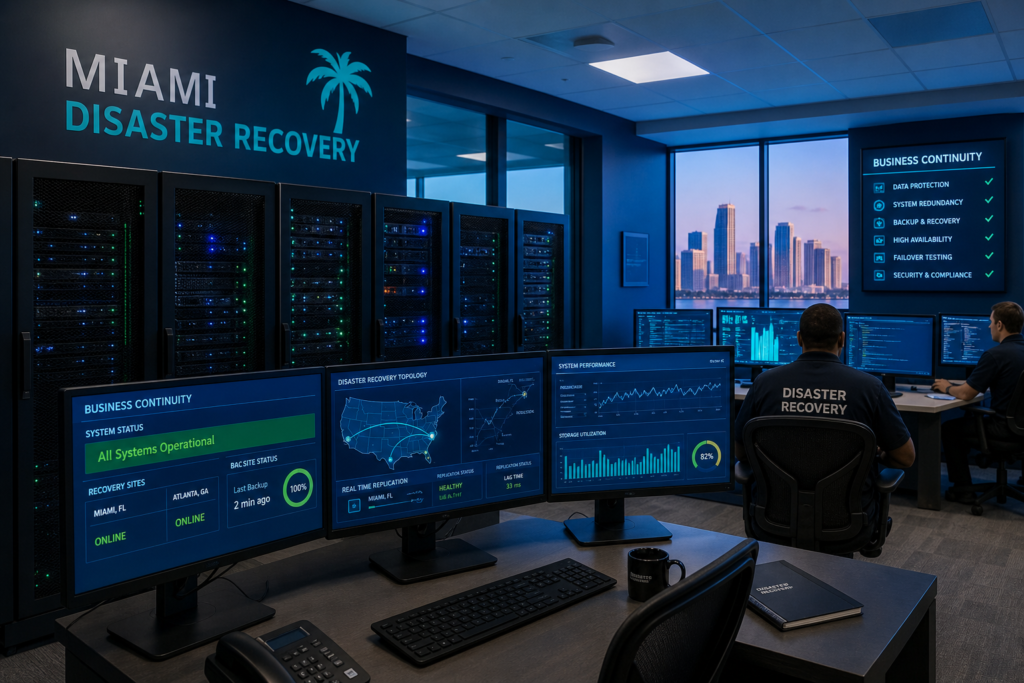
IT disaster recovery in Miami means having a tested, documented plan that restores your firm’s data and systems within hours — not days — after a ransomware attack, hardware failure, or hurricane. For accounting firms, law firms, and medical practices in South Florida, downtime is not just an inconvenience: it is a compliance violation, a liability, and a direct hit to client trust.
At Transform 42 Inc, a Service-Disabled Veteran-Owned Small Business providing managed IT in Miami, we build and test disaster recovery plans for professional services firms every day. This guide covers what a real IT disaster recovery and business continuity plan (BCP) looks like for your firm, what your MSP should be doing proactively, and what it costs to get it wrong.
Why Miami Professional Services Firms Are High-Value Disaster Targets
Miami-Dade and Broward counties face a unique combination of threat vectors that few other markets deal with simultaneously: annual Atlantic hurricane season (June–November), a dense concentration of small professional firms holding highly regulated data, and some of the highest ransomware targeting rates of any metro area in the country per the FBI Miami Field Office. In 2024, the FBI’s Internet Crime Complaint Center (IC3) recorded over $900 million in cybercrime losses in Florida alone.
Accounting firms hold tax returns, payroll data, and financial statements. Law firms hold privileged client communications, settlement records, and matter files. Medical practices hold protected health information (PHI) governed by HIPAA. All three verticals have mandatory breach notification requirements — and none of them can afford to lose data permanently or be offline for more than a few hours.
The Real Cost of Downtime in South Florida Professional Services
Downtime cost varies by firm size and vertical, but the numbers are consistently punishing:
| Firm Type | Avg. Revenue Per Hour | Estimated Downtime Cost (8 hrs) | Compliance Fine Risk |
|---|---|---|---|
| 5-attorney law firm | $1,200–$2,500 | $9,600–$20,000 | ABA/Florida Bar ethics violation |
| 10-CPA accounting firm | $800–$1,800 | $6,400–$14,400 | IRS data security plan failure (Rev. Proc. 2007-40) |
| 5-physician medical practice | $2,000–$5,000 | $16,000–$40,000 | HIPAA breach notification (45 CFR §164.400) |
Those figures do not include ransom payments, forensic investigation costs, legal fees, or the long-term reputational damage from a publicly disclosed breach. A 2024 IBM Cost of a Data Breach Report puts the average total cost of a healthcare data breach at $9.77 million — and that is not limited to large hospital systems.
What a Real IT Disaster Recovery Plan Looks Like for Miami Firms
A disaster recovery plan is not a backup drive under someone’s desk. It is a documented, regularly tested set of procedures that covers people, systems, data, and communication when something goes wrong. Here is what your managed IT provider should have in place:
1. Recovery Time Objective (RTO) and Recovery Point Objective (RPO)
Your RTO is how long you can survive offline. Your RPO is how much data you can afford to lose. Most Miami professional services firms need an RTO of 2–4 hours and an RPO of 15–60 minutes. If your MSP cannot tell you these numbers for your firm specifically, they have not built you a real plan.
For accounting firms using QuickBooks Online, CCH Axcess, or Drake Tax — losing even 4 hours during busy season (January–April 15) can cause missed client deadlines, IRS penalties, and client departures. For law firms using Clio or NetDocuments, losing access to matter files mid-litigation is a malpractice exposure. For medical practices on Epic, athenahealth, or eClinicalWorks, losing PHI access during patient care creates a HIPAA reportable event.
2. The 3-2-1-1 Backup Architecture
The standard 3-2-1 backup rule (3 copies, 2 media types, 1 offsite) is now the minimum. In 2026, the correct framework is 3-2-1-1: three copies, two media types, one offsite, and one air-gapped or immutable copy. Immutable backups cannot be encrypted by ransomware — they are the difference between paying a ransom and restoring your own data.
- On-premise backup appliance: Datto SIRIS or Acronis Cyber Protect for local bare-metal restore (fastest recovery). Datto’s cloud-direct restore can spin up a virtual machine of your server in under 60 minutes.
- Cloud-replicated backup: Veeam Cloud Connect or Azure Backup replicating every 15–30 minutes to a geographically separate data center. For Hurricane season, this means your data survives even if your Miami office is physically damaged.
- Immutable offsite archive: Wasabi Cloud Storage or Backblaze B2 with Object Lock enabled. Ransomware cannot touch these — they are write-once, read-many.
- Microsoft 365 backup: Microsoft’s native 365 retention is not a backup. Your MSP should run Veeam for Microsoft 365 or Acronis Cloud Backup separately to protect Exchange, SharePoint, OneDrive, and Teams data.
3. Endpoint Detection and Response (EDR) as the First Line
Disaster recovery is faster when you catch the attack before it spreads. EDR tools like CrowdStrike Falcon, SentinelOne Singularity, or Microsoft Defender for Business monitor every endpoint in real time. When ransomware begins encrypting files, EDR kills the process within seconds — before it can spread to your file server or backup target.
For Miami professional services firms with 10–50 workstations, EDR typically costs $8–$18 per endpoint per month. That is far less than the $50,000–$200,000 average ransomware recovery cost reported by Coveware’s Q4 2024 Ransomware Report.
4. Documented Runbooks and Communication Trees
A disaster recovery plan lives in a document, not in the head of your IT person. Your plan should include a step-by-step runbook for each failure scenario (ransomware, hardware failure, ISP outage, building access loss), a communication tree showing who calls whom and in what order, and client notification templates ready to send within 72 hours (required under HIPAA for breaches affecting 500+ individuals, and under Florida’s FDUTPA for any data breach).
5. Annual Tabletop Exercises and Quarterly Backup Tests
A backup that has never been tested is a backup you cannot trust. Your MSP should run a quarterly restore test — actually pulling data from backup and validating it matches production — and at least one annual tabletop exercise where your team walks through a simulated incident. HIPAA’s Security Rule (45 CFR §164.308(a)(7)) explicitly requires covered entities to implement and test contingency plans.
Business Continuity vs. Disaster Recovery: What’s the Difference?
Disaster recovery focuses on restoring IT systems after an outage. Business continuity is broader — it covers how your firm keeps operating even while systems are being restored. For a Miami accounting firm, business continuity might mean staff switching to a pre-approved cloud workstation environment (Microsoft Azure Virtual Desktop or Citrix) and processing returns remotely while the main server is being rebuilt. For a law firm, it might mean enabling Clio’s cloud access from employee personal devices with MFA enforced.
Transform 42 builds both layers for accounting firms, law firms, and medical practices in Miami. The goal is that your clients never know something happened.
IT Disaster Recovery Checklist for Miami Professional Services Firms
Use this checklist to evaluate whether your current IT provider has the basics covered:
- Documented RTO and RPO targets specific to your firm
- 3-2-1-1 backup architecture with immutable offsite copy
- Separate Microsoft 365 backup (not relying on Microsoft’s native retention)
- EDR deployed on every endpoint, server, and mobile device
- Backup restore tested within the last 90 days with documented results
- Written incident response runbook with step-by-step procedures
- Staff communication tree for disaster scenarios
- Client notification templates ready for HIPAA/FDUTPA compliance
- Remote access failover (Azure Virtual Desktop, Citrix, or VPN) tested and working
- Annual tabletop exercise completed with at least two staff members
- Hurricane season prep: generator plan, building access backup, ISP failover (4G/5G)
Hurricane Season IT Prep: A South Florida-Specific Requirement
No national MSP template accounts for the reality of Hurricane season in Miami-Dade and Broward. A serious storm can mean 3–10 days without power or physical office access. Your disaster recovery plan should include:
- ISP failover: A 4G/5G cellular backup router (Cradlepoint or Peplink) that automatically switches when fiber goes down. Cost: $300–$600 hardware, $50–$100/month for cellular data.
- UPS and generator plan: APC or Eaton UPS units on servers and network gear, with a documented generator plan if your building provides one or a portable generator contract for extended outages.
- Pre-storm runbook: A specific checklist to execute 48–72 hours before a storm makes landfall — confirming cloud backups are current, enabling remote access for all staff, shutting down physical servers safely if needed.
- Cloud-first document storage: Firms still storing critical files on local file servers face the highest risk. Moving to SharePoint Online, NetDocuments cloud, or Clio’s cloud storage before hurricane season is the single highest-impact change most firms can make.
What IT Disaster Recovery Costs for a Miami Small Firm
Here is a realistic cost breakdown for a 10–25 user professional services firm in Miami:
| Component | Monthly Cost | Annual Cost |
|---|---|---|
| Datto SIRIS backup appliance + cloud | $300–$600 | $3,600–$7,200 |
| Microsoft 365 backup (Veeam or Acronis) | $50–$120 | $600–$1,440 |
| EDR (CrowdStrike or SentinelOne, 20 endpoints) | $160–$360 | $1,920–$4,320 |
| ISP failover (cellular backup) | $100–$150 | $1,200–$1,800 |
| DR plan documentation + annual tabletop | $100–$200 | $1,200–$2,400 (one-time $500–$1,500 setup) |
| Total | $710–$1,430/mo | $8,520–$17,160/yr |
Compare that to the average ransomware recovery cost of $180,000 (Coveware, 2024) or the cost of a single HIPAA breach penalty (OCR settlements range from $100,000 to $3 million for small practices). The economics are not close.
How Transform 42 Builds and Tests Disaster Recovery Plans
Transform 42 Inc is a managed IT provider based in Miami serving accounting firms, law firms, and medical practices across South Florida. As a Service-Disabled Veteran-Owned Small Business, we bring operational discipline from military mission planning to IT continuity work — which means your disaster recovery plan is built to hold up under real-world pressure, not just look good in a three-ring binder.
Our standard DR engagement for a professional services firm includes:
- Initial risk assessment and gap analysis against your current backup/recovery posture
- RTO/RPO definition and architecture design specific to your vertical (accounting, law, or healthcare)
- Implementation of 3-2-1-1 backup stack with tested immutable offsite copy
- EDR deployment and configuration across all endpoints
- Written disaster recovery runbook and business continuity plan
- Quarterly backup restore tests with written reports
- Annual tabletop exercise facilitated by our team
- Hurricane season pre-storm checklist and ISP failover setup
Ready to find out whether your current setup would survive a ransomware attack or Category 3 hurricane? Schedule a free IT assessment with our team and we will walk through your current DR posture, identify the gaps, and give you a clear remediation plan — no sales pressure, no jargon.
Frequently Asked Questions: IT Disaster Recovery Miami
What is IT disaster recovery for a Miami law firm or accounting firm?
IT disaster recovery for a Miami professional services firm is a documented plan that defines how your systems, data, and operations will be restored after a ransomware attack, hardware failure, hurricane, or other disruptive event. It specifies your Recovery Time Objective (how long you can be offline), your Recovery Point Objective (how much data you can lose), and the step-by-step procedures your IT team and staff follow to get back online. For accounting firms and law firms, a disaster recovery plan also addresses compliance requirements — such as the IRS Written Information Security Plan (WISP) and ABA Formal Opinion 498.
How often should a small professional services firm test its backup and disaster recovery plan?
Small firms should perform a full backup restore test at least once per quarter and complete an annual tabletop exercise simulating a disaster scenario. HIPAA requires covered entities to test their contingency plans and document the results. Many accounting firms also include DR testing in their IRS WISP annual review. If your MSP cannot show you a written report from a recent restore test, your backups have not been validated.
What is the best backup solution for a Miami accounting firm or law firm?
The best backup solution for a Miami professional services firm combines a local backup appliance (Datto SIRIS or Acronis Cyber Protect) for fast on-site recovery, a cloud-replicated backup for offsite protection during hurricanes or physical office damage, and an immutable cloud archive (Wasabi with Object Lock or Backblaze B2) that ransomware cannot encrypt. Microsoft 365 data should be backed up separately using Veeam for Microsoft 365 or Acronis, since Microsoft’s native retention is not a substitute for a real backup.
How does hurricane season affect IT disaster recovery planning in South Florida?
Hurricane season (June–November) requires Miami firms to add location-specific elements to their disaster recovery plan that national MSP templates typically miss. These include ISP failover via 4G/5G cellular backup routers, generator plans for extended power outages, a pre-storm runbook executed 48–72 hours before landfall, and cloud-first document storage so staff can work remotely if the office is inaccessible for days or weeks. Firms that store critical data only on local servers are at severe risk if their building floods or loses power for an extended period.
What should I look for when choosing an MSP for disaster recovery in Miami?
When choosing a managed IT provider for disaster recovery in Miami, look for a firm that can define your specific RTO and RPO targets, has implemented and tested immutable backup architectures, performs documented quarterly restore tests, provides written incident response runbooks, and has experience with your specific industry compliance requirements (HIPAA for medical practices, IRS WISP for accounting firms, ABA cybersecurity ethics for law firms). Also ask whether they have a hurricane-specific IT preparedness protocol — national MSPs without Miami experience frequently lack one.
Transform 42 provides managed IT services for accounting firms in Miami.