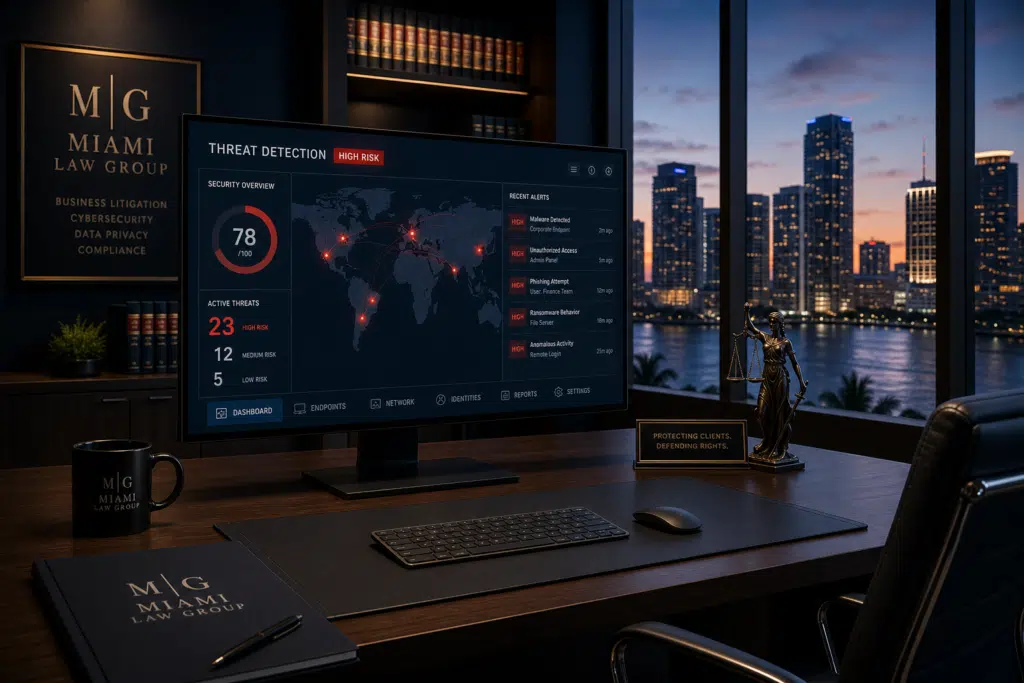
Sixty-eight percent of law firm data breaches originate at the endpoint — a compromised laptop, an unmonitored workstation, a partner’s personal MacBook connected to Clio. For Miami law firms managing confidential client matters, sensitive billing records, and privileged communications, that statistic is not abstract. It is a liability exposure that ABA ethics rules, Florida law, and cyber insurance underwriters are increasingly measuring in real dollars.
Endpoint detection and response (EDR) is now the security baseline that separates insurable, compliant Miami law firms from those operating on borrowed time. Legacy antivirus — the kind that checks a file’s signature against a known list — stops roughly 40% of modern threats. EDR stops over 99%, by watching what every process on every device actually does, in real time, and killing anything that behaves like malware before it can encrypt a single client file.
This guide explains what EDR is, why it matters specifically for Miami law firms running Clio, iManage Work, or NetDocuments, how the two leading platforms — CrowdStrike Falcon and SentinelOne Singularity — compare in a legal IT context, and what compliance obligations make EDR effectively mandatory in 2026.
Why Antivirus Is No Longer Enough for Law Firms
Traditional antivirus software was designed for a threat landscape that no longer exists. It compares incoming files against a database of known malicious signatures. Attackers defeated this model years ago by using fileless malware, living-off-the-land (LotL) techniques, and encrypted payloads that look benign until they execute.
According to the CrowdStrike 2024 Global Threat Report, 75% of attacks detected in 2023 were malware-free — meaning they used legitimate system tools like PowerShell, WMI, and remote desktop protocols to move through networks without triggering signature-based detection. Law firm environments are particularly vulnerable because attorneys frequently use personal devices, connect to client networks from hotel Wi-Fi, and share documents via email outside managed channels.
The FBI’s 2024 Internet Crime Report identified law firms as one of the top five targeted industries for business email compromise (BEC) and ransomware, with Miami-Dade County representing one of the highest concentrations of BEC losses in the United States — $47 million in 2024 alone. The majority of those incidents began with a single compromised endpoint.
What Endpoint Detection and Response Actually Does
EDR is a security technology that installs a lightweight agent on every managed device — Windows workstations, MacBooks, servers, and virtual machines. That agent records everything: every process that starts, every file opened, every network connection made, every registry key modified. It streams that telemetry to a cloud analysis engine that applies behavioral AI to identify malicious patterns.
When something anomalous is detected — a process attempting to encrypt hundreds of files simultaneously, a browser spawning a command shell, a script trying to exfiltrate data to an unfamiliar IP address — EDR responds in milliseconds. Depending on configuration, it can isolate the affected device from the network, kill the malicious process, roll back encrypted files, and alert the security team with a full attack timeline.
For a Miami law firm, this means that even if a ransomware payload reaches an associate’s laptop through a phishing email, the EDR platform contains it before it can reach the Clio matter database, the iManage document vault, or the billing server. The contamination radius shrinks from “entire firm” to “one isolated device.”
ABA Ethics Requirements and Florida Law
Miami law firms operate under layered compliance obligations that make EDR effectively non-optional in 2026.
ABA Model Rule 1.6 and Formal Opinion 477R
ABA Model Rule 1.6(c) requires lawyers to make reasonable efforts to prevent unauthorized disclosure of client information. ABA Formal Opinion 477R (2017, updated 2023) clarifies that “reasonable” must account for the sensitivity of the information and the threat landscape at the time. In 2026, deploying endpoint monitoring on devices that access client data is considered a reasonable minimum measure by both the ABA Technology Center and leading legal malpractice carriers.
Florida Bar Ethics Opinion 20-1
Florida Bar Ethics Opinion 20-1 extends these obligations to Florida-licensed attorneys, specifically referencing cloud-based legal applications and the requirement to assess the security controls of technology vendors handling client data. Firms using Clio, NetDocuments, or iManage must verify that their local endpoint security complements the vendor’s cloud security — because the cloud platform is only as secure as the device accessing it.
Florida Information Protection Act (FIPA) — FL Statute §501.171
Florida Statute §501.171 requires any entity maintaining personal information of Florida residents to implement reasonable safeguards to protect that information and to notify affected individuals within 30 days of a breach. For Miami law firms that maintain personal data on clients, opposing parties, witnesses, and employees, a breach involving unencrypted client files triggers mandatory notification obligations — and potential civil liability for failure to implement reasonable security measures. EDR is explicitly cited by Florida regulators as an appropriate technical safeguard.
CrowdStrike Falcon vs. SentinelOne Singularity: Which Is Right for Your Miami Practice?
Both CrowdStrike Falcon and SentinelOne Singularity are MITRE ATT&CK evaluation leaders and satisfy ABA, FIPA, and cyber insurance requirements. The right choice depends on your firm’s size, IT staffing model, and legal applications.
| Feature | CrowdStrike Falcon | SentinelOne Singularity |
|---|---|---|
| Detection model | AI + threat intelligence (Threat Graph) | Behavioral AI (autonomous) |
| Remediation | Manual or guided (analyst-driven) | Autonomous rollback + kill |
| Threat intelligence | Industry-leading (OverWatch MDR) | Strong (WatchTower MDR add-on) |
| macOS support | Excellent | Excellent |
| Ransomware rollback | Available (Falcon Prevent) | Built-in (1-click rollback) |
| Best for firm size | 20+ attorneys with IT staff | 5–75 attorneys via MSP |
| Clio/iManage integration | Via API (custom) | Via API (custom) |
| Price (per device/mo) | $18–$28 (via MSP) | $15–$25 (via MSP) |
| MITRE ATT&CK score | 99.7% detection (2023 eval) | 100% detection (2023 eval) |
For most Miami law firms with 5 to 50 attorneys managed by an MSP, SentinelOne Singularity is the practical recommendation. Its autonomous remediation means threats are contained even at 2 AM on a Saturday without requiring an analyst to intervene. CrowdStrike Falcon is the preferred choice for larger litigation firms (50+ attorneys) that have in-house security staff and want the deepest threat intelligence and fastest incident response times.
How EDR Protects Clio, iManage, and NetDocuments
Miami law firms have migrated heavily to cloud-based legal platforms — Clio Manage for matter management and billing, iManage Work for document management, and NetDocuments for cloud document storage. Each of these platforms authenticates via browser sessions or desktop applications running on local endpoints. That is the attack surface EDR protects.
Credential Harvesting Attacks
The most common law firm breach scenario in 2024 was not ransomware — it was credential theft. Attackers use infostealer malware (RedLine, Lumma, Vidar) to extract saved browser passwords, session cookies, and authentication tokens from attorney devices. Once they have a valid Clio or iManage session token, they can access client data without triggering the cloud platform’s login anomaly detection. EDR detects and kills infostealer processes before credential extraction completes.
Ransomware in a Document Management Environment
Ransomware targeting law firms typically targets the NetDocuments or iManage sync folders on local devices — encrypting the local cache and triggering the sync client to push encrypted files to the cloud, overwriting clean versions. EDR detects the mass-encryption behavior pattern within the first 5–10 files and halts the process before sync propagation. SentinelOne’s rollback feature can restore those initial encrypted files automatically.
Insider Threat and Departing Employee Risk
EDR provides visibility into large data exfiltration events — an associate downloading every matter file to a USB drive before joining a competing firm, or a departing partner bulk-exporting Clio contacts. EDR telemetry feeds into DLP (data loss prevention) policies that can alert IT administrators when abnormal data movement occurs on managed endpoints.
Cyber Insurance Requirements for 2026
The cyber insurance market’s underwriting standards for law firms have hardened significantly since 2022. Carriers including Coalition, Beazley, and Cowbell now list EDR as a required control — not a preferred one — for law firm policies above $500,000 in coverage. The Coalition 2024 Cyber Claims Report found that 80% of ransomware incidents involved victims without EDR deployed, and carriers have responded by making EDR non-negotiable.
Firms that submit renewal applications without EDR can expect one of three outcomes: premium increases of 30–60%, coverage exclusions for ransomware events (the most common claim type for law firms), or outright declination. By contrast, verified EDR deployment typically yields a 10–20% premium reduction, partially or fully offsetting the product cost.
The Complete Law Firm Endpoint Security Stack
EDR is the cornerstone of a law firm endpoint security program, but it works best as part of a layered stack:
- EDR (CrowdStrike Falcon or SentinelOne Singularity) — Real-time threat detection and autonomous response across all managed devices
- Microsoft Entra ID + Conditional Access — Identity-based access control; blocks Clio and iManage logins from unmanaged or non-compliant devices
- Microsoft Intune (MDM/MAM) — Device compliance enforcement; EDR agent deployment and health verification across the fleet
- Microsoft Defender for Business — Complementary email and identity protection; integrates with M365 data governance
- Datto or Veeam backup with immutable storage — Offline, air-gapped backups of matter files and document management systems; ransomware cannot encrypt what it cannot reach
- KnowBe4 or Proofpoint security awareness training — Phishing simulation and training to reduce the human-layer risk that delivers payloads to endpoints in the first place
Transform 42 Inc deploys and manages this complete stack for Miami law firms as part of our managed IT services for law firms program. Every engagement includes EDR deployment, M365 security hardening, backup verification, and cyber insurance documentation — the evidence package your carrier requires at renewal.
EDR Deployment: What the Process Looks Like
For a Miami law firm transitioning from legacy antivirus to EDR, the deployment process typically runs four to six weeks:
- Device inventory and assessment — Catalog all managed and unmanaged endpoints, identify operating systems, verify Intune enrollment status, and remove legacy AV agents.
- Policy configuration — Configure EDR detection policies for the firm’s specific applications (Clio, iManage, NetDocuments, Outlook, Adobe, practice management software). Set exclusion rules to prevent false positives on legitimate legal workflows.
- Silent deployment — Push agents via Intune or RMM to all managed devices. Attorneys experience zero interruption; the agent operates invisibly in the background.
- Monitoring and tuning (weeks 3–4) — Review telemetry, tune detection thresholds, and document any legitimate processes flagged during the initial period.
- Full enforcement mode — Enable autonomous response (isolation and remediation). Generate the insurance compliance report for carrier documentation.
- Ongoing managed detection — Monthly health checks, agent updates, and quarterly threat hunting reviews included in managed service.
Cost-Benefit Analysis for a 15-Attorney Miami Firm
The financial case for EDR is straightforward when measured against actual law firm breach costs:
| Scenario | Annual Cost |
|---|---|
| EDR (SentinelOne, 20 devices via MSP) | $4,800/year ($20/device/mo) |
| Cyber insurance premium reduction (15%) | –$2,100/year savings |
| Net EDR cost | ~$2,700/year |
| Average ransomware demand for law firms (Coveware Q4 2024) | $1,300,000 |
| Average law firm breach remediation cost (IBM 2024) | $4,800,000 |
| Average downtime cost for a 15-attorney firm (billing impact) | $25,000/day |
The net annual cost of managed EDR — approximately $2,700 after insurance savings — represents less than 0.2% of a single ransomware demand. For a 15-attorney firm billing $750/hour average, a five-day outage costs more than five years of EDR fees.
Why Miami Law Firms Need a Managed Service Provider for EDR
Deploying EDR software is not the same as operating an EDR program. Both CrowdStrike and SentinelOne generate thousands of alerts per week. Without trained analysts to triage, prioritize, and respond to those alerts, the technology provides a false sense of security. Many Miami law firms that attempted to deploy EDR independently found themselves with a dashboard full of unreviewed alerts and no capacity to act on them.
A managed service provider that specializes in legal IT — like Transform 42 Inc — handles the operational burden: configuring detection policies, triaging alerts 24/7, responding to incidents, maintaining agent updates, and producing the quarterly compliance reports your cyber insurance carrier and legal malpractice insurer require. The firm gets enterprise-grade security without the overhead of an in-house security operations center.
As a Service-Disabled Veteran-Owned Small Business, Transform 42 Inc brings a mission-driven approach to law firm security. Our team understands the ABA ethics obligations, Florida Bar requirements, and cyber insurance underwriting criteria that Miami attorneys navigate — and we build those requirements into every managed security engagement.
Frequently Asked Questions
What is endpoint detection and response (EDR) and why do law firms need it?
Endpoint detection and response (EDR) is a cybersecurity technology that continuously monitors devices — laptops, workstations, and servers — for malicious activity, automatically containing threats before they spread. Miami law firms need EDR because 68% of data breaches originate at the endpoint, ABA Formal Opinion 477R requires competent cybersecurity measures, and cyber insurance carriers now list EDR as a baseline underwriting requirement.
Which EDR solution is best for Miami law firms — CrowdStrike Falcon or SentinelOne Singularity?
Both are excellent. CrowdStrike Falcon excels at threat intelligence and is preferred by large litigation firms with dedicated IT staff. SentinelOne Singularity offers superior autonomous remediation and is often the better choice for small to mid-size Miami firms (5–75 attorneys) managed by an MSP, because it requires less analyst intervention to contain threats.
Does ABA ethics rules require law firms to have EDR?
ABA Model Rule 1.6, ABA Formal Opinion 477R, and Florida Bar Ethics Opinion 20-1 require lawyers to implement reasonable safeguards for client data. While the ABA does not mandate a specific product, EDR is now considered a minimum reasonable measure by both the ABA Technology Center and leading cyber insurance carriers. Firms without EDR face elevated liability exposure in the event of a breach.
How does EDR protect Clio, iManage, and NetDocuments environments?
EDR agents monitor every process on every device in real time. If ransomware attempts to encrypt Clio matter data, iManage document stores, or NetDocuments sync folders, EDR isolates the device within milliseconds. EDR also detects credential-harvesting attacks targeting SSO sessions and browser-stored passwords for legal applications.
What does EDR cost for a Miami law firm, and is it covered by cyber insurance savings?
EDR for a 10–30 attorney firm typically costs $18–$35 per device per month through a managed service provider. Most cyber insurance carriers offer 5–15% premium discounts for firms with verified EDR deployment, translating to $1,200–$4,500/year in savings for a typical Miami firm — partially or fully offsetting the product cost.
Get EDR-Managed Security for Your Miami Law Firm
Transform 42 Inc provides fully managed endpoint detection and response for Miami law firms, including CrowdStrike Falcon and SentinelOne Singularity deployment, 24/7 monitoring, incident response, and cyber insurance compliance documentation. Our legal IT specialists understand the Clio, iManage, and NetDocuments environments your practice depends on — and we keep them running and protected.
Ready to move beyond legacy antivirus? Request a free IT security assessment and we will audit your current endpoint coverage, identify gaps, and provide a deployment roadmap — at no cost. You can also explore our full law firm IT services or learn about our complete managed IT offering for Miami professional services firms.