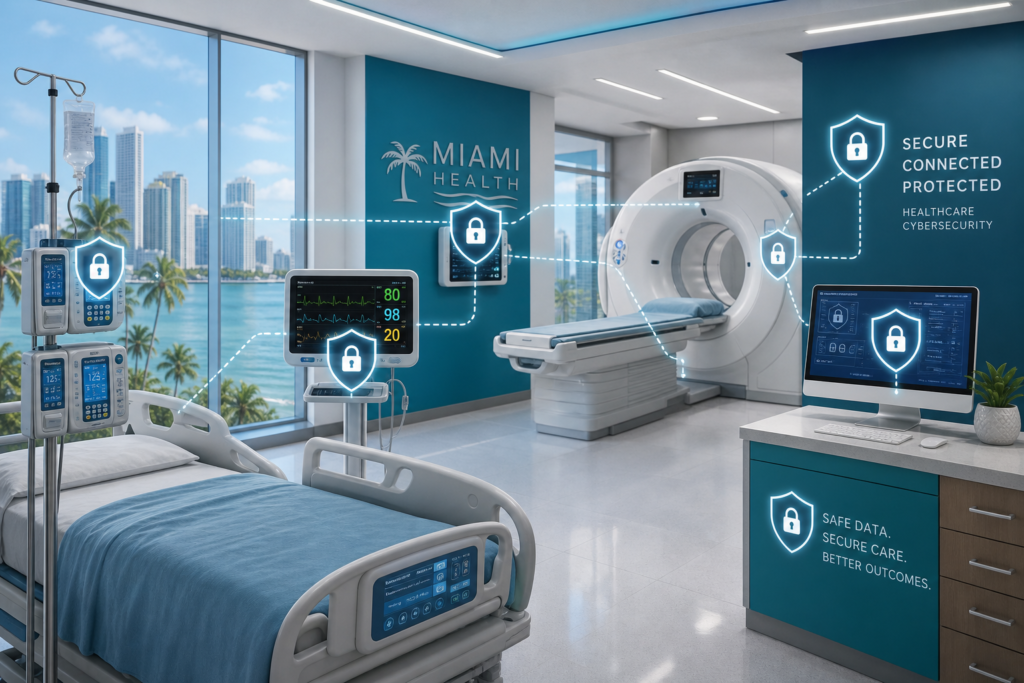
Connected medical devices are the fastest-growing attack surface in U.S. healthcare — and most medical practices in Miami have dozens of them on the same network as their EHR. The FDA’s 2023 MedTech Cybersecurity Guidance and HIPAA’s technical safeguard requirements under 45 CFR §164.312 make medical device security a compliance obligation, not a nice-to-have. A qualified MSP manages network segmentation, firmware patching, device inventory, and incident response so your clinical staff never has to choose between security and patient care.
Why Medical Devices Are a Top HIPAA Attack Vector
The Claroty Team82 2023 State of Healthcare IoT Security report found that 63% of FDA-recalled medical devices had known unpatched vulnerabilities, and 51% ran Windows 7 or older operating systems. Infusion pumps, imaging systems, patient monitors, and wearables all transmit or store ePHI — making them HIPAA-covered assets subject to the Security Rule.
Attackers specifically target these devices because they are rarely patched, often connected to flat networks with EHR access, and manufacturers frequently prohibit changes that would trigger FDA re-approval. For a 5- to 20-physician practice in Miami, a single compromised infusion pump can expose the entire Epic, athenahealth, or eClinicalWorks environment on the same network segment.
IBM’s Cost of a Data Breach 2024 report places the average healthcare breach at $9.77M — the highest of any industry for the 14th consecutive year. A significant share of those breaches trace back to unmanaged networked devices.
HIPAA and the FDA’s 2023 Cybersecurity Guidance: What They Require
HIPAA’s technical safeguards (45 CFR §164.312) require covered entities to implement technical security measures that prevent unauthorized access to ePHI transmitted over electronic communications networks. When a medical device carries ePHI — and most modern devices do — the Security Rule applies to that device.
The FDA’s December 2023 Cybersecurity in Medical Devices Guidance expanded on this with specific requirements for device manufacturers and healthcare delivery organizations:
- Network segmentation: Medical devices must be isolated from general IT and EHR networks using VLANs or micro-segmentation
- Asset inventory: Every networked medical device must be catalogued with make, model, firmware version, and network address
- Vulnerability management: Practices must have a documented process for tracking CVEs against device models
- Incident response: Device-specific incident response procedures must exist in the HIPAA Security Incident Response Plan
- Business Associate Agreements: Vendors with remote access to devices that store or transmit ePHI must sign a BAA
Florida’s Department of Health and the Office for Civil Rights (OCR) enforcement actions have increasingly cited unmanaged medical devices as contributing factors in breach investigations. OCR’s Tier 3 penalties start at $13,785 per violation — and each device left out of scope can be treated as a separate violation.
The 5 Device Categories Miami Practices Must Inventory
Before your MSP can secure medical devices, they must find them all. Most Miami practices are surprised to discover how many connected devices are on their network. Here are the five categories that require attention:
- Infusion pumps and smart medication systems: BD Alaris, Baxter Spectrum, ICU Medical — all have documented CVEs. Many run VxWorks or embedded Linux with no patch mechanism except factory firmware update
- Diagnostic imaging systems: X-ray, ultrasound, MRI controllers, PACS servers — these typically run Windows 10 or older and connect directly to the clinical network for DICOM image transfer
- Patient monitoring systems: Vital sign monitors, telemetry units, ECG/EEG systems — often connected via Wi-Fi with hardcoded credentials in legacy models
- Wearables and remote patient monitoring (RPM) devices: AliveCor KardiaMobile, iRhythm Zio, continuous glucose monitors (Dexcom, Abbott Libre) — these communicate via smartphone apps and Bluetooth, introducing mobile endpoint risk
- Administrative and clinical support devices: Smart printers with fax capability, check-in kiosks, digital intake tablets, video conferencing endpoints — frequently overlooked but all on the network
What Your MSP Must Implement: A 7-Layer Medical Device Security Stack
Securing medical devices requires a layered approach that works within manufacturer constraints. A qualified MSP for Miami medical practices implements these seven controls:
1. Network Segmentation with Clinical VLANs
Your MSP configures separate VLANs for medical devices, clinical workstations, EHR servers, and administrative systems. A Fortinet FortiGate or Cisco Meraki firewall enforces east-west traffic rules so a compromised infusion pump cannot reach your Epic or athenahealth database. Inter-VLAN routing is restricted to specific, documented clinical workflows only.
2. Medical Device Asset Management (MDAM)
Your MSP deploys a passive network scanning solution — Claroty, Armis, or Medigate — that discovers and inventories every device on the clinical network without installing agents (which manufacturers prohibit). The inventory includes device type, vendor, model, firmware version, operating system, known CVEs, and network connections. This inventory is the foundation of your HIPAA asset management obligation under §164.310(d).
3. Firmware and Patch Management
Where manufacturers provide firmware updates, your MSP schedules and applies them during clinical off-hours (typically 10 PM–5 AM for Miami practices with extended hours). For devices that cannot be patched, your MSP documents compensating controls — network isolation, access control, monitoring — in writing for HIPAA audit purposes. This satisfies OCR’s “addressable” implementation specification requirement.
4. Privileged Access and Credential Management
Default credentials (admin/admin, service accounts with blank passwords) are rotated across all manageable devices. Vendor remote access sessions are controlled via a PAM (Privileged Access Management) solution — CyberArk or BeyondTrust — that requires MFA and logs all session activity. No vendor gets persistent VPN access; sessions are time-limited and require approval.
5. Network Traffic Monitoring and Anomaly Detection
Your MSP deploys network detection and response (NDR) on the clinical network to monitor device behavior baselines. An infusion pump that suddenly begins scanning other IP addresses or initiating outbound connections is immediately flagged. Tools like Darktrace Healthcare or ExtraHop Reveal(x) are purpose-built for clinical environments and integrate with your SIEM for 24/7 SOC alerting.
6. Endpoint Protection on Manageable Devices
For medical devices running Windows — imaging systems, PACS workstations, clinical PCs — your MSP deploys CrowdStrike Falcon or SentinelOne with healthcare-specific exclusions to avoid disrupting clinical software. Devices running embedded Linux or proprietary OS are protected at the network level via the VLAN controls and NDR monitoring described above.
7. Device-Specific Incident Response
Your HIPAA Security Incident Response Plan (required under §164.308(a)(6)) must include device-specific runbooks: what to do when a medical device is compromised, how to isolate it without disrupting patient care, how to notify the manufacturer, and how to report to OCR within the 60-day breach notification window. Your MSP maintains these runbooks and conducts annual tabletop exercises with your clinical leadership.
Medical Device Security Stack: Cost Reference
The following table represents approximate monthly costs for a Miami medical practice with 5–15 providers and 20–60 networked medical devices:
| Component | Tool/Vendor | Monthly Cost |
|---|---|---|
| Medical Device Asset Management | Claroty / Armis / Medigate | $800–$1,800 |
| Network Segmentation (firewall) | Fortinet FortiGate / Cisco Meraki | $300–$600 |
| NDR / Network Monitoring | Darktrace Healthcare / ExtraHop | $600–$1,200 |
| Endpoint Protection (Windows devices) | CrowdStrike / SentinelOne | $200–$500 |
| PAM (vendor access control) | CyberArk / BeyondTrust | $400–$800 |
| SIEM + 24/7 SOC alerting | Managed SOC via MSP | $500–$1,000 |
| Total | $2,800–$5,900/mo |
Compare that to the $9.77M average healthcare breach cost (IBM 2024) or the $50,000–$1.9M OCR civil monetary penalties for HIPAA Security Rule violations. Medical device security is not a cost — it is a risk transfer with a compelling return.
The Miami-Specific Risk Factors
Miami-Dade County’s healthcare sector has specific characteristics that elevate medical device risk:
- International patient volume: Miami’s position as a Latin American healthcare hub means practices manage patients who may bring their own RPM devices (CGMs, cardiac monitors) from countries with different regulatory standards — devices that may not meet FDA security guidelines
- Hurricane season disruption: Power fluctuations during storms can force medical devices to reboot into default configuration states, potentially exposing credentials or resetting security settings. Your MSP must include device post-storm verification in the disaster recovery runbook
- Multi-location practices: Many Miami medical groups operate 3–8 locations across Miami-Dade and Broward counties — each location adds a network perimeter and a device inventory that must be managed consistently
- Telehealth integration: Post-COVID telehealth adoption in Miami has connected more patient-side devices to clinical networks. Your telehealth IT infrastructure must account for RPM device data flows
3 Questions to Ask Your Current IT Provider
If you have an IT provider today, ask them these three questions. The answers will tell you quickly whether they are equipped for healthcare environments:
- Can you show me our current medical device inventory? If they cannot produce a list with device type, firmware version, and network location within 24 hours, you have an undocumented attack surface.
- What is your process for CVE tracking against our specific device models? Generic patch management tools do not track vulnerabilities in FDA-regulated medical devices. They need a clinical-aware process.
- How do vendor remote access sessions work, and where are the logs? If vendors have standing VPN access with no MFA and no session recording, your HIPAA audit trail has a significant gap.
How Transform 42 Inc Approaches Medical Device Security
Transform 42 Inc is a Service-Disabled Veteran-Owned Small Business providing managed IT for Miami medical practices. Our approach to medical device security is grounded in HIPAA technical safeguard requirements and FDA 2023 cybersecurity guidance:
- Full medical device discovery and inventory on day one of engagement — passive scanning, no agent installation required
- Clinical VLAN architecture isolating devices from EHR systems and administrative networks
- CVE tracking against your specific device models, with documented compensating controls for unpatched devices
- Vendor access management with session logging and MFA enforcement
- Device-specific HIPAA incident response runbooks updated annually
- 24/7 network monitoring with clinical-environment NDR tuned to reduce false positives for normal medical device behavior
Our team works alongside your clinical leadership — not around them. We document everything in writing for HIPAA audits, provide quarterly security posture reviews, and integrate with your Miami IT support engagement so device security is part of your overall IT program, not a siloed project.
Ready to find out what is actually on your clinical network? Request a medical device security assessment — we will inventory your devices, identify gaps against HIPAA and FDA guidance, and give you a prioritized remediation plan within 10 business days.
Frequently Asked Questions
What is medical device security in healthcare?
Medical device security is the set of IT controls — network segmentation, asset inventory, vulnerability management, access control, and monitoring — applied to connected clinical devices (infusion pumps, imaging systems, patient monitors, wearables) to prevent unauthorized access to ePHI and disruption of patient care. HIPAA’s technical safeguards under 45 CFR §164.312 require covered entities to apply security measures to every networked device that stores or transmits electronic protected health information.
Are medical devices covered under HIPAA?
Yes. Any networked medical device that creates, receives, maintains, or transmits ePHI is subject to HIPAA’s Security Rule. This includes infusion pumps with logging capability, PACS workstations, patient monitors, and remote patient monitoring devices. HIPAA does not exempt devices because they are FDA-regulated — both sets of requirements apply simultaneously.
What is the biggest cybersecurity risk from medical devices?
The biggest risk is lateral movement: an attacker compromises a low-security medical device (such as an infusion pump with a default password) and uses that foothold to move across the clinical network to the EHR database. Because medical devices are often on flat networks and cannot run endpoint detection software, they serve as persistent entry points. Network segmentation — isolating devices on dedicated VLANs with strict firewall rules — is the primary control that prevents lateral movement.
How does the FDA’s 2023 cybersecurity guidance affect Miami medical practices?
The FDA’s December 2023 Cybersecurity in Medical Devices Guidance requires manufacturers of new devices to provide a Software Bill of Materials (SBOM) and support post-market security patching. For healthcare delivery organizations like medical practices, the guidance reinforces the obligation to segment devices, maintain an asset inventory, manage vendor access, and have documented incident response procedures. While the FDA’s enforcement focus is on manufacturers, OCR uses the guidance as a benchmark when evaluating HIPAA Security Rule compliance during breach investigations.
What should I look for in an MSP for medical device security in Miami?
Look for an MSP with direct experience in clinical environments, not just general IT security. Key capabilities include: passive medical device discovery (no agent installation), clinical VLAN architecture, CVE tracking for FDA-regulated device models, vendor access management with session logging, HIPAA Security Rule documentation, and device-specific incident response runbooks. Ask for references from Miami-area medical practices and verify that their security stack includes healthcare-specific NDR tools — not just generic endpoint protection.