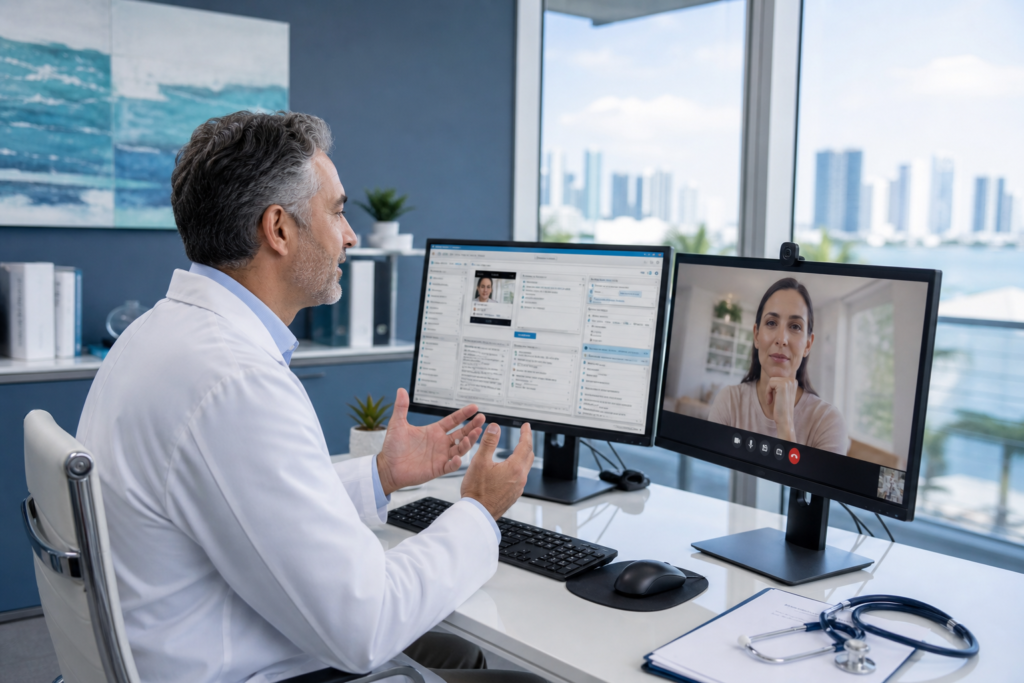
Telehealth is no longer a pandemic workaround for Miami medical practices — it is a permanent service line that requires permanent IT infrastructure. The right setup means HIPAA-compliant video platforms, sufficient bandwidth, hardened endpoints, and clean EHR integration. The wrong setup means a $50,000+ OCR fine, dropped patient calls, and clinician frustration.
This guide covers exactly what telehealth IT infrastructure for Miami medical practices requires in 2026 — and what your managed IT provider must handle to keep you compliant, connected, and competitive.
Why Telehealth IT Infrastructure Is Not Optional
The American Medical Association’s 2023 Telehealth Survey found that 85% of physicians now use telehealth. In Florida, the Telehealth Act (Section 456.47, F.S.) codifies standards for remote encounters, while HIPAA’s Security Rule (45 CFR §164.312) mandates technical safeguards for any electronic protected health information (ePHI) transmitted during a telehealth session.
The OCR enforces these standards aggressively. In 2023, Manasa Health (a New Jersey telehealth provider) paid $30,000 after failing to execute Business Associate Agreements with three HIPAA-covered video vendors. The lesson: every technology vendor that touches patient data needs a BAA before the first appointment.
For Miami practices competing in a healthcare market where 62% of patients now expect telehealth as a standard service option (Doximity 2024 State of Telemedicine Report), the infrastructure investment is also a revenue decision.
HIPAA-Compliant Telehealth Platforms: The Foundation
The first infrastructure decision is your video platform. Not every video conferencing product is HIPAA-compliant by default — and using a non-compliant platform for a patient call is a reportable breach regardless of whether PHI was discussed.
The leading HIPAA-compliant telehealth platforms for medical practices in 2026 include:
| Platform | Best For | EHR Integration | BAA Available | Pricing (approx.) |
|---|---|---|---|---|
| Doxy.me | Small practices, independent providers | Limited (API-based) | Yes | Free – $50/provider/mo |
| Zoom for Healthcare | Multi-provider practices | Epic, athenahealth, Cerner | Yes | $200+/mo |
| Microsoft Teams for Healthcare | M365-integrated practices | Epic (MyChart), Oracle Health | Yes (via M365) | Included in M365 Business Premium |
| Teladoc Health | Enterprise health systems | Native integrations | Yes | Custom pricing |
| Updox | Independent and small group practices | Broad EHR API support | Yes | $149/provider/mo |
Every platform above requires specific configuration before go-live: end-to-end encryption enabled, waiting room functionality activated, session recording disabled (or stored in a HIPAA-compliant location), and the signed BAA on file. Your managed IT provider should verify all of these before the first patient call.
Bandwidth and Network Infrastructure
A single HD telehealth call consumes approximately 3-5 Mbps of symmetrical bandwidth. For a five-provider Miami practice running concurrent telehealth sessions while staff processes claims, retrieves EHR records, and handles email, the math escalates quickly.
The recommended network baseline for a telehealth-enabled practice:
- Primary internet connection: 100-500 Mbps symmetrical fiber (AT&T Business Fiber, Comcast Business, or Hotwire Communications serve most of Miami-Dade and Broward)
- Failover connection: 4G/5G cellular backup (Cradlepoint or Peplink routers with dual-SIM failover). A dropped telehealth call mid-consultation is both a care quality issue and a HIPAA documentation gap.
- Network segmentation: VLAN separation between telehealth traffic, EHR traffic, administrative traffic, and guest/patient Wi-Fi. This limits breach scope if one segment is compromised.
- QoS (Quality of Service) rules: Prioritize video conferencing and VoIP traffic over background system updates and file syncs.
- Hardware: Business-grade firewall (Fortinet FortiGate or Cisco Meraki MX), managed switches, and Wi-Fi 6 access points for clinical areas where clinicians may use mobile devices.
Miami’s hurricane season (June through November) creates a real risk of extended outages. Practices relying on cable or DSL as their only internet connection should treat the 4G/5G failover line as a compliance requirement, not an optional upgrade.
Endpoint Security for Telehealth Devices
Every device used by a clinician for telehealth — desktop, laptop, tablet, or smartphone — is an ePHI endpoint under HIPAA. HIPAA’s Security Rule requires technical safeguards at the device level: unique user authentication, automatic session timeouts, encryption of data at rest, and audit controls.
The minimum endpoint security stack for telehealth-capable devices includes:
- Endpoint Detection and Response (EDR): CrowdStrike Falcon, SentinelOne Singularity, or Microsoft Defender for Endpoint. Traditional antivirus is insufficient for detecting credential-harvesting attacks that target healthcare networks.
- Full-disk encryption: BitLocker (Windows) or FileVault (macOS) enabled and escrow keys managed in your MDM solution.
- Mobile Device Management (MDM): Microsoft Intune or Jamf for enforcing security policies, remote wipe capability, and app management on all devices accessing the telehealth platform or EHR.
- Multi-factor authentication (MFA): Microsoft Authenticator or Duo Security on all accounts with access to patient data — including the telehealth platform, EHR, email, and VPN.
- Patch management: Automated OS and application patching within 14 days of release. Unpatched endpoints are the leading initial access vector in healthcare ransomware attacks.
The HHS Office for Civil Rights and CISA have both flagged healthcare as a top-targeted sector. In 2023, healthcare accounted for 18% of all reported ransomware attacks in the United States (HHS HC3 Sector Alert, March 2024). For Miami practices serving patients in South Florida’s densely connected healthcare ecosystem, perimeter-only security is not a credible defense.
EHR Integration: Closing the Documentation Loop
A telehealth session that is not automatically linked to the patient record creates a documentation gap, a billing gap, and a compliance gap. Clinicians end up manually copying notes from a video call into the EHR — a workflow that increases error rates and eliminates the efficiency advantage telehealth is supposed to deliver.
The leading EHR platforms used by Miami medical practices and their telehealth integration status:
- Epic (MyChart): Native telehealth via Epic Telehealth module. Integrates directly with Zoom for Healthcare and Microsoft Teams for Healthcare. Encounter documentation, billing codes (CPT 99213, 99214 modifier -95 or -GT), and after-visit summaries generate automatically.
- athenahealth: athenaTelehealth module built-in. Supports Zoom for Healthcare integration. Automated charge capture and payer-specific telehealth billing rule sets.
- eClinicalWorks (eCW): healow TeleVisit platform is native to eCW. Requires healow subscription on top of base eCW license. Integrates with eCW’s revenue cycle management module.
- DrChrono: Built-in telehealth with HIPAA-compliant video. Strong for smaller practices and concierge medicine models. Apple iPad-native.
If your practice uses an EHR that does not have a native telehealth module, your IT provider needs to configure an API-based integration between your video platform and EHR, or implement middleware (such as Redox or Mirth Connect) to handle the data exchange. This is a non-trivial configuration that requires healthcare IT expertise — not a general IT generalist.
Business Associate Agreements: The Legal Layer Your IT Provider Must Own
Under HIPAA, any vendor that handles ePHI on behalf of your practice is a Business Associate and must sign a Business Associate Agreement before receiving access to patient data. The list of vendors requiring a BAA in a telehealth environment is longer than most practice administrators expect:
- Your telehealth video platform (Doxy.me, Zoom, Teams)
- Your EHR vendor
- Your managed IT services provider
- Your cloud backup vendor (Datto, Veeam, Azure Backup)
- Your email provider (Microsoft 365 — covered under the M365 BAA)
- Any scheduling or patient portal software
- Your medical billing service
A HIPAA-compliant managed IT provider will maintain a complete BAA inventory as part of your HIPAA risk management program, not leave it as an administrative afterthought. Transform 42 Inc executes BAAs with all healthcare clients before any access to patient systems begins.
Staff Training and Change Management
The infrastructure can be perfectly configured and still fail at the clinical level if staff are not trained on the telehealth workflow. HIPAA’s Administrative Safeguards (45 CFR §164.308) require formal workforce training on policies and procedures related to ePHI — and telehealth represents a new category of ePHI handling for most clinical teams.
A practical telehealth training program covers:
- How to launch and close a compliant telehealth session (no personal devices, no personal email for patient communications)
- How to document the encounter in the EHR immediately after the call
- What to do if the video connection drops mid-call (documented fallback: phone call or rescheduled appointment)
- How to verify patient identity at the start of each telehealth session (Florida Telehealth Act requirement)
- Incident reporting procedures if a session is accidentally recorded or joined by an unauthorized third party
Your managed IT provider should deliver this training at go-live and refresh it annually or when you onboard new clinical staff. Annual training documentation is required for HIPAA compliance.
What the Total Telehealth IT Setup Costs in Miami
Miami practices frequently ask what a telehealth IT buildout costs. Costs vary significantly by practice size, existing infrastructure maturity, and EHR platform, but the following ranges apply to small and mid-sized practices (1-10 providers):
| Component | One-Time Cost | Monthly Cost |
|---|---|---|
| HIPAA-compliant video platform | $0–$500 setup | $50–$200/provider |
| Network upgrade (firewall, switches, Wi-Fi 6) | $2,500–$8,000 | $0 (hardware) |
| Failover internet (4G/5G router) | $400–$800 (hardware) | $80–$150 (data plan) |
| EDR + MDM licensing | $0 | $8–$20/endpoint |
| EHR telehealth module activation | $0–$2,000 (EHR-dependent) | Included or +$50–$150/provider |
| HIPAA training + documentation | $500–$1,500 | $0 (annual refresh ~$500) |
| Managed IT support (ongoing) | — | $100–$200/user/month |
For a five-provider practice starting from a basic IT baseline, plan for a one-time investment of $8,000–$15,000 and ongoing monthly costs of $2,500–$4,500 covering internet, security, telehealth platform, and managed IT support. Practices that already have managed IT from T42 typically need only incremental investment to activate telehealth layers on existing infrastructure.
How Transform 42 Sets Up Telehealth IT for Miami Medical Practices
Transform 42 Inc is a healthcare IT managed services provider and Service-Disabled Veteran-Owned Small Business serving medical practices throughout Miami-Dade and Broward Counties. Our telehealth IT implementation process:
- Assessment: Audit existing network, endpoints, EHR, and current HIPAA compliance posture before recommending any changes
- Platform selection: Recommend and procure the HIPAA-compliant telehealth platform that integrates with your specific EHR and fits your practice size
- Infrastructure: Upgrade network hardware, configure VLAN segmentation, set up failover internet, deploy EDR and MDM on all endpoints
- EHR integration: Configure API or native integration between telehealth platform and Epic, athenahealth, eClinicalWorks, DrChrono, or other platforms
- BAA management: Execute Business Associate Agreements with all applicable vendors and maintain the BAA inventory as part of your HIPAA program
- Training: Deliver staff training on the telehealth workflow and document completion for HIPAA compliance records
- Ongoing support: Monitor, patch, and manage the entire stack under a managed IT services agreement with guaranteed response times
We also provide general IT support in Miami and broader IT services covering cybersecurity, cloud, compliance, and vCIO strategy for growing practices. Our team holds BAAs with every healthcare client before touching any patient system — the legal documentation comes first, every time.
Frequently Asked Questions
What IT infrastructure does a Miami medical practice need for telehealth?
A Miami medical practice needs a HIPAA-compliant video platform (such as Doxy.me, Zoom for Healthcare, or Microsoft Teams for Healthcare), a minimum 100 Mbps symmetrical fiber internet connection with a 4G/5G failover line, endpoint security (EDR and MDM) on all devices used for patient calls, EHR integration with Epic, athenahealth, or eClinicalWorks, and a signed Business Associate Agreement with every technology vendor involved in patient data.
Does telehealth require a separate IT setup from the rest of my practice?
Not necessarily a separate setup, but telehealth does require specific configurations layered on top of your existing infrastructure — HIPAA-compliant video conferencing, network segmentation to isolate telehealth traffic, dedicated bandwidth allocation, and endpoint hardening. A managed IT provider can configure these as an overlay on your current environment.
What HIPAA requirements apply to telehealth platforms in Florida?
Under HIPAA, any telehealth platform that transmits protected health information must use end-to-end encryption, enforce role-based access controls, maintain audit logs of all sessions, and provide a signed Business Associate Agreement. Florida’s Telehealth Act (Section 456.47, F.S.) additionally mandates informed consent and documentation standards for telehealth encounters.
How much bandwidth does a telehealth practice in Miami need?
A single HD telehealth call requires approximately 3-5 Mbps symmetrical bandwidth. For a 5-provider practice running concurrent calls plus EHR traffic and office operations, plan for a minimum 100 Mbps fiber connection with a 4G/5G failover link. Miami’s fiber providers — AT&T Business Fiber, Comcast Business, and Hotwire Communications — offer competitive options for medical practices.
Can Transform 42 set up telehealth IT infrastructure for our Miami medical practice?
Yes. Transform 42 Inc is a Service-Disabled Veteran-Owned Small Business providing managed IT services to Miami medical practices. Our healthcare IT team handles HIPAA-compliant telehealth platform setup, EHR integration, network infrastructure, endpoint security, staff training, and ongoing support — all with a signed Business Associate Agreement. Contact us for a free IT assessment.