Nearly 90 percent of accounting firms now use data analytics to strengthen their decision-making, signaling a huge shift in how accountants impact business growth. With financial data pouring in from every direction, the ability to extract meaningful insights is no longer a bonus—it shapes who stays competitive. This article breaks down how data analytics is transforming accounting practices into powerful engines for future-ready strategy, security, and success.
Table of Contents
- Defining Data Analytics In Accounting Practices
- Major Types Of Data Analytics Explained
- How Data Analytics Drives Firm Performance
- Compliance, Security, And Privacy Requirements
- Risks, Costs, And Common Pitfalls To Avoid
Key Takeaways
| Point | Details |
|---|---|
| Embrace Data Analytics | Data analytics is vital for accountants, transitioning them from traditional roles to strategic advisors driving business decisions. |
| Diverse Analytical Techniques | Understanding descriptive, diagnostic, predictive, and prescriptive analytics is essential for maximizing financial insights and guiding effective strategies. |
| Assess Compliance and Security | Accounting firms must prioritize data security, regulatory compliance, and client privacy to maintain trust and safeguard sensitive information. |
| Navigate Risks and Costs | Awareness of potential financial, technical, and strategic pitfalls is crucial; firms should implement a strategic approach to ensure successful data analytics adoption. |
Defining Data Analytics in Accounting Practices
Data analytics has transformed accounting from a numbers-tracking profession into a strategic powerhouse of business intelligence. According to inaa.org, data analytics in accounting involves systematically examining financial data to extract meaningful insights, patterns, and trends that enable accountants to not just report past performance, but predict future outcomes and guide critical decision-making.
At its core, data analytics represents a powerful toolkit that goes way beyond traditional spreadsheet calculations. As research from online.se.edu reveals, modern accounting data analytics empowers professionals to anticipate economic patterns, improve operational processes, track performance metrics, and proactively mitigate potential financial risks. CFOs increasingly recognize this approach as a key contributor to enhanced financial performance.
The practical applications of data analytics in accounting are incredibly diverse. Accountants can now leverage advanced analytical techniques to:
- Identify unusual financial transactions or potential fraud patterns
- Predict cash flow fluctuations with remarkable accuracy
- Optimize tax strategies by uncovering hidden financial insights
- Develop more precise financial forecasting models
- Support management in making data-driven strategic decisions

For accounting professionals looking to stay competitive, understanding and implementing data analytics isn’t just an option—it’s quickly becoming a professional necessity. Explore our guide on digital transformation to understand how technology is reshaping the accounting landscape and creating new opportunities for strategic insight.
Major Types of Data Analytics Explained
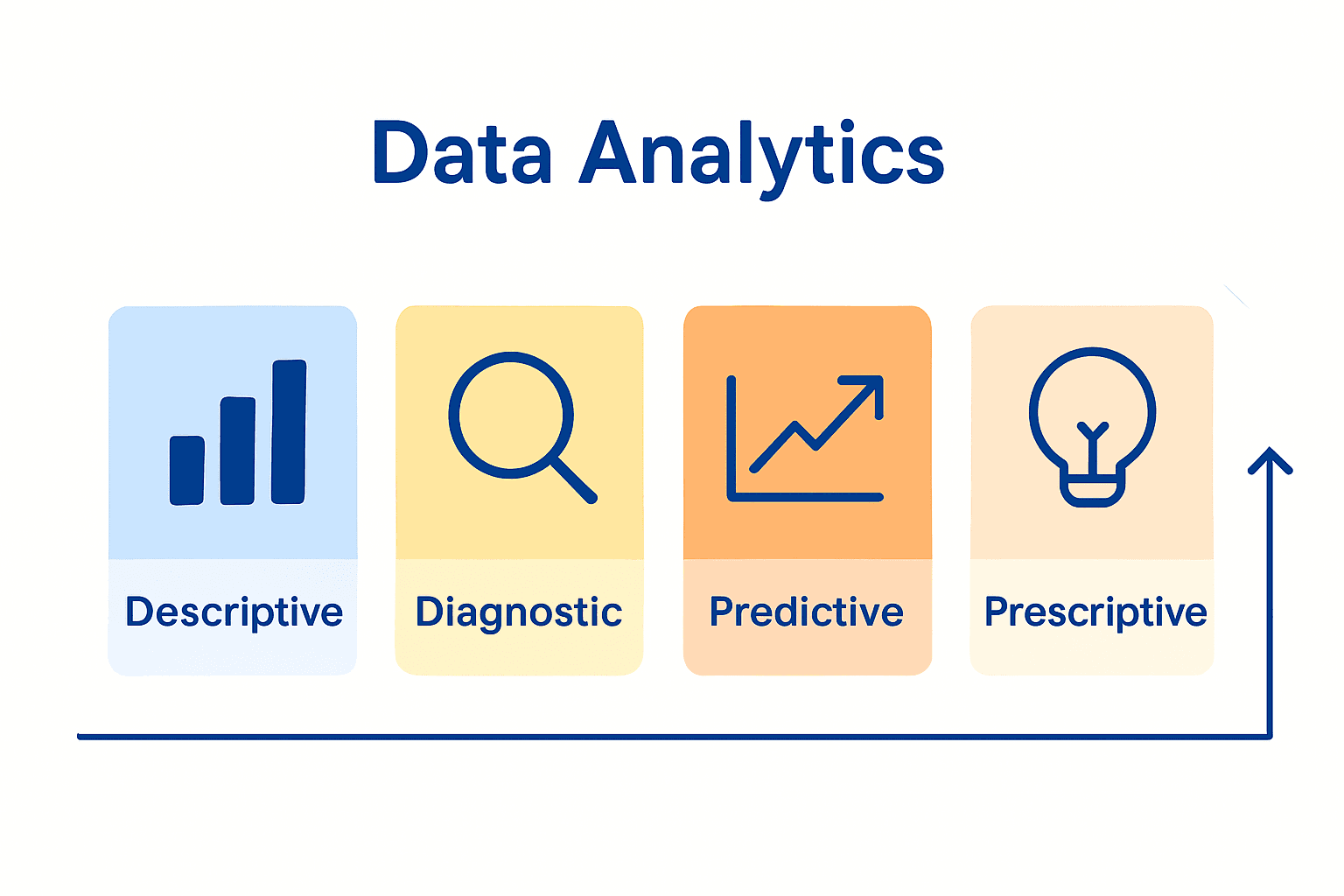
In the world of modern accounting, data analytics isn’t a monolithic concept but a sophisticated toolkit with multiple specialized approaches. According to Coursera, there are four primary types of finance analytics that provide increasingly complex insights and strategic capabilities for accounting professionals.
Let’s break down these data analytics types in a way that makes sense for real-world accounting practices. As research from Discover Data Science highlights, each type serves a unique purpose in transforming raw financial information into actionable business intelligence:
- Descriptive Analytics
- Summarizes historical financial data
- Provides a clear picture of past performance
- Answers “What happened?”
- Diagnostic Analytics
- Investigates why specific financial outcomes occurred
- Identifies root causes of financial trends
- Helps understand complex financial patterns
- Predictive Analytics
- Uses historical data to forecast future financial scenarios
- Anticipates potential revenue, risks, and opportunities
- Enables proactive financial planning
- Prescriptive Analytics
- Recommends specific actions based on predictive insights
- Suggests strategic financial decisions
- Helps optimize financial processes and strategies
For accounting professionals eager to stay ahead of technological shifts, understanding digital transformation is crucial in leveraging these advanced analytical techniques effectively. By mastering these four types of data analytics, CPAs can transform from number crunchers to strategic business advisors who drive meaningful financial decision-making.
How Data Analytics Drives Firm Performance
In today’s hyper-competitive accounting landscape, data analytics has emerged as a game-changing tool for transforming firm performance. According to inaa.org, by systematically analyzing large datasets, accounting firms can uncover hidden patterns that lead to optimized operations, dramatically improved risk management, and a substantial competitive advantage.
Research from Franklin University underscores how data analytics empowers accounting professionals to create more accurate reports, develop sophisticated predictive models, and provide strategic insights that directly enhance decision-making processes. This isn’t just about number-crunching anymore—it’s about transforming raw financial data into actionable intelligence that drives meaningful business outcomes.
The performance benefits of data analytics for accounting firms are multi-dimensional:
-
Operational Efficiency
- Streamline internal processes
- Reduce manual data entry and reconciliation time
- Automate complex financial analyses
-
Risk Management
- Identify potential financial irregularities
- Predict and mitigate potential financial risks
- Enhance fraud detection capabilities
-
Strategic Decision Making
- Provide data-driven insights for leadership
- Support more accurate financial forecasting
- Enable proactive business strategy development
To truly leverage these transformative capabilities, accounting firms must embrace technological evolution. Learn more about data-driven enterprise strategies that can help your firm stay ahead of the curve and turn data into your most powerful competitive asset. The future of accounting isn’t just about maintaining financial records—it’s about using data to tell a compelling story of business potential.
Compliance, Security, and Privacy Requirements
In the world of data analytics, navigating the complex landscape of compliance, security, and privacy isn’t just a technical challenge—it’s a critical business imperative. According to Accounting Professor, businesses must ensure rigorous compliance with regulations related to data collection and use, including privacy protection, data security, and anti-discrimination laws, while maintaining absolute transparency to build client trust and mitigate potential legal risks.
As inaa.org emphasizes, utilizing big data analytics in accounting requires a comprehensive approach to protecting sensitive financial information. This means implementing robust security protocols that go far beyond traditional safeguarding methods.
Key compliance and security considerations for accounting firms include:
-
Data Protection Fundamentals
- Encrypt all sensitive financial data
- Implement multi-factor authentication
- Establish strict access control protocols
-
Regulatory Compliance
- Stay current with GDPR, CCPA, and other data protection regulations
- Develop clear data usage consent procedures
- Maintain detailed audit trails of data access
-
Privacy Management
- Anonymize client data when possible
- Create transparent data handling policies
- Provide clear opt-out mechanisms for data collection
-
Risk Mitigation
- Conduct regular security vulnerability assessments
- Develop comprehensive incident response plans
- Train staff on data protection best practices
Confronting cybersecurity challenges requires a proactive, holistic approach. For accounting firms, protecting client data isn’t just about technology—it’s about building a culture of security, trust, and responsible data management that puts client confidentiality at the forefront of every decision.
Risks, Costs, and Common Pitfalls to Avoid
Data analytics in accounting isn’t just about embracing new technology—it’s about navigating a complex landscape of potential challenges and hidden risks. According to inaa.org, while big data analytics offers tremendous benefits, accounting professionals must be acutely aware of significant risks, including potential data breaches, substantial implementation costs, and the critical need for specialized skills to avoid costly missteps.
Research from Franklin University highlights that implementing data analytics requires more than just technological investment—it demands a strategic approach to mitigate common pitfalls that can derail even the most well-intentioned digital transformation efforts. The key is understanding and proactively addressing potential challenges before they become expensive problems.
Critical risks and potential pitfalls for accounting firms include:
-
Financial Risks
- Unexpected high implementation costs
- Potential return on investment uncertainties
- Hidden expenses in technology and training
-
Technical Challenges
- Data quality and accuracy issues
- Integration complexity with existing systems
- Skill gap in advanced analytics capabilities
-
Operational Vulnerabilities
- Misinterpretation of complex data insights
- Over-reliance on automated analytics
- Insufficient data governance protocols
-
Strategic Mistakes
- Rushing implementation without proper planning
- Neglecting staff training and change management
- Failing to align analytics with business objectives
Confronting cybersecurity challenges requires a holistic perspective. For accounting firms, successful data analytics adoption isn’t about avoiding risks entirely—it’s about developing a mature, strategic approach that anticipates challenges, invests in continuous learning, and maintains flexibility in an ever-evolving technological landscape.
Unlock the Full Potential of Data Analytics for Your Accounting Firm
The Essential Guide to the Role of Data Analytics highlights critical challenges like maintaining ironclad compliance, ensuring data security, and overcoming the complexities of implementation. If your Miami accounting firm struggles with these issues or wants to transform raw financial data into accurate insights while avoiding costly pitfalls, you need a trusted partner who aligns technology with your business goals.
Discover how Transform42 offers the specialized IT solutions designed for accounting professionals. With nonstop reliability, 99.99% uptime, and guaranteed rapid response times, we help you eliminate unplanned downtime, reduce regulatory risks, and safeguard sensitive data as you master predictive and prescriptive analytics.
Experience peace of mind by partnering with experts who understand how to integrate data analytics technologies seamlessly while ensuring full compliance and security. Visit our website Transform42 IT Solutions now and take the first step to turning your data into your firm’s most powerful strategic asset. Don’t wait until a data breach or costly downtime impacts your business. Learn how to safeguard your future today.
Frequently Asked Questions
What is data analytics in accounting?
Data analytics in accounting involves systematically examining financial data to extract insights, patterns, and trends that assist accountants in predicting future outcomes and making informed decisions.
What are the major types of data analytics used in accounting?
The four primary types of data analytics used in accounting are descriptive analytics, diagnostic analytics, predictive analytics, and prescriptive analytics, each serving different purposes for transforming financial information into actionable insights.
How does data analytics improve firm performance in accounting?
Data analytics enhances firm performance by optimizing operations, improving risk management, increasing operational efficiency, and enabling data-driven strategic decision-making.
What are the common pitfalls to avoid when implementing data analytics in accounting?
Common pitfalls include underestimating implementation costs, facing data quality issues, neglecting staff training, and rushing implementation without a structured plan.
Recommended
- Data-Driven Governance: The Future of Policy Making
- The New Imperative: Data-Driven Enterprise Architecture
- Navigating the New Normal: A Proactive Approach to Healthcare Data Security
- Navigating the AI Revolution: A Guide for the C-Suite
- Using Data for Content Strategy: Drive Results in 2025
- database interviews – ParakeetAI