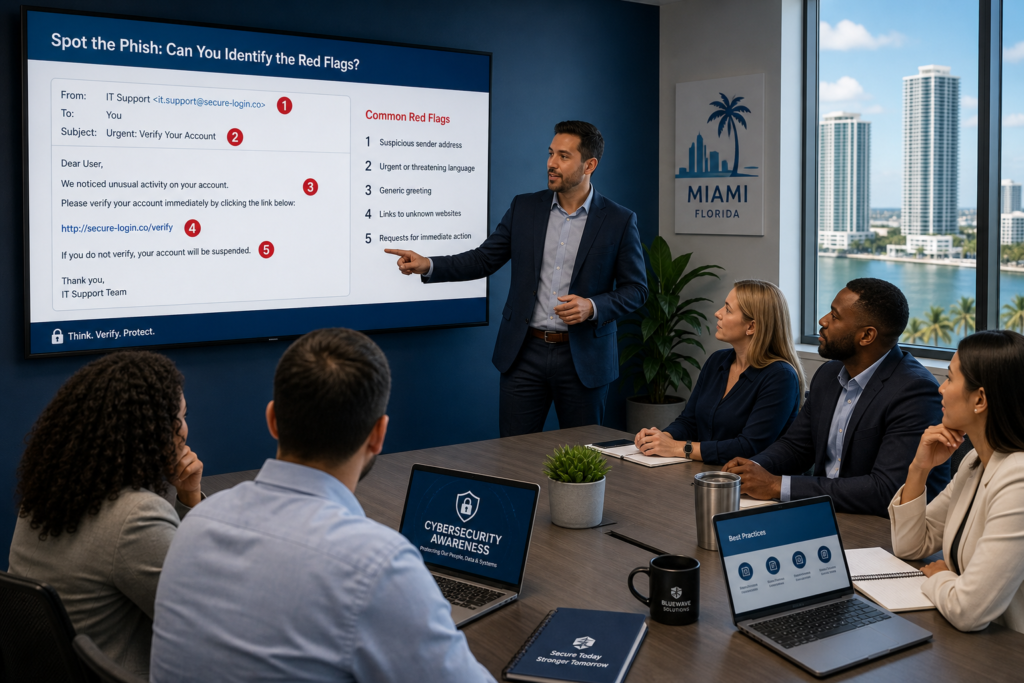
Security awareness training is the single highest-ROI cybersecurity investment for Miami professional services firms. The reason is simple: over 80 percent of breaches start with a human mistake — a clicked phishing link, a reused password, or a wire transfer sent to a spoofed email address. No firewall or endpoint agent stops an employee who has been tricked. Training does.
For CPA firms, law firms, and medical practices in Miami, the stakes are higher than most. You hold financial records, privileged communications, and protected health information — data that commands premium prices on the dark web and triggers mandatory breach notifications. Regulators, courts, and insurers now expect a documented training program. This guide explains what a real program looks like, which platforms your MSP should run, and what your compliance frameworks require.
Why Human Error Drives Professional Services Breaches
The Verizon 2024 Data Breach Investigations Report found that 68 percent of breaches involved a human element — phishing, stolen credentials, or social engineering. For professional services firms, the threat landscape is specific:
- Business Email Compromise (BEC): An attacker spoofs the managing partner’s email and instructs accounts payable to wire funds to a new vendor account. The FBI’s IC3 reported $2.9 billion in BEC losses in 2023. CPA firms handling tax payments and real estate closings are prime targets.
- W-2 and payroll fraud: During tax season, attackers email HR posing as employees requesting payroll direct deposit changes. The IRS warned of a 870 percent increase in W-2 phishing during filing season.
- Client file exfiltration: Ransomware groups targeting law firms increasingly use double extortion — encrypting files and threatening to publish client communications unless a ransom is paid. Clio’s 2024 Legal Trends Report noted ransomware as the top technology security concern among managing partners.
- EHR credential theft: Medical practices face targeted credential-harvesting campaigns against Epic, athenahealth, and eClinicalWorks portals. A single compromised provider login exposes every patient record in the system.
No patch or configuration blocks these attacks. Only a trained employee who recognizes the red flags does.
What Compliance Frameworks Require
HIPAA Security Rule — Medical Practices
HIPAA’s Security Rule (45 CFR §164.308(a)(5)) requires covered entities and business associates to implement a security awareness and training program for all workforce members. Required topics include: protection from malicious software, procedures for monitoring log-in attempts, and password management. OCR investigators look for training completion records in every audit and breach investigation. Lack of documented training is a tier 2 violation — up to $100,000 per incident category — and has appeared in multiple settlement agreements, including the $750,000 Advocate Medical Group settlement.
ABA Ethics and Bar Compliance — Law Firms
ABA Model Rule 1.1 (Competence) requires lawyers to understand the benefits and risks of technology used in their practice. Florida Bar Guideline 6-10.3 and the ABA’s Standing Committee on Ethics guidance make clear that competent representation includes safeguarding client confidences from foreseeable cybersecurity threats. ABA Formal Opinion 477R specifies that attorneys must take reasonable measures to prevent unauthorized access, including training staff on phishing and social engineering. A firm that suffers a breach because employees were never trained faces ethics complaints, disciplinary proceedings, and civil malpractice exposure.
Cyber Insurance Underwriting Requirements
Coalition, Beazley, Chubb, Travelers, and Hartford now use automated security scans and underwriting questionnaires that ask directly: “Does your organization conduct periodic security awareness training?” and “Do you run simulated phishing campaigns?” Answering no increases premiums and may disqualify applicants from coverage. After a breach, insurers audit training records before paying claims. Firms that cannot produce completion logs, phishing simulation results, or acknowledgment records face denial — even if a policy was in force.
The Four Components of a Real Security Awareness Program
A checkbox training program — one annual video that employees click through in five minutes — does not change behavior and will not satisfy an insurer or regulator. A managed program run by your MSP has four active components.
1. Simulated Phishing Campaigns
Your MSP sends realistic phishing emails to your staff using templates that mirror real attack patterns: invoice approval requests, DocuSign notifications, voicemail links, Microsoft 365 credential pages, and wire transfer authorization requests. Employees who click are redirected to a brief training moment — not shamed, but educated in real time. Campaigns run monthly at minimum. Click-through rates should drop from an industry average of 30 percent at baseline to under 5 percent within six months of consistent training.
Platforms your MSP should be running: KnowBe4 (largest phishing template library, 12,000+ templates, direct Microsoft 365 integration, compliance-specific modules for HIPAA, SOC 2, and bar ethics) or Proofpoint Security Awareness (strong threat intelligence integration, recommended for firms already running Proofpoint email filtering).
2. Role-Based Training Modules
Generalized training is less effective than role-targeted content. An accounts payable staffer at a CPA firm needs BEC and wire fraud training. A medical receptionist needs PHI handling and HIPAA breach reporting training. A paralegal needs privilege and metadata scrubbing training. A good platform delivers short, 5-10 minute modules (not 60-minute annual courses) mapped to each employee’s role and the firm’s specific risk profile.
| Role | Priority Training Topics | Compliance Driver |
|---|---|---|
| CPA / Accountant | BEC, wire fraud, W-2 phishing, tax fraud | IRS Publication 4557, cyber insurance |
| Attorney / Paralegal | Phishing, privilege, metadata, e-discovery | ABA Rule 1.1, Florida Bar 6-10.3 |
| Medical Provider | PHI handling, EHR credential security, HIPAA breach | HIPAA §164.308(a)(5) |
| Front Desk / Admin | Social engineering, vishing, tailgating, BEC | All vertical compliance |
| IT / Technical Staff | Privileged access, insider threat, security controls | SOC 2, HIPAA, cyber insurance |
3. Policy Acknowledgment and Documentation
Regulators and insurers need documentation. A managed training platform captures timestamped completion records, quiz scores, and policy sign-offs. Your MSP should generate quarterly compliance reports showing training completion by employee, phishing simulation results by department, and trend data over time. This documentation is your defense in an OCR audit, a bar complaint, or an insurance claim review.
4. Incident Reporting Culture
Training is only complete when employees feel comfortable reporting suspicious activity without fear of punishment. Your MSP should establish a clear reporting mechanism — a dedicated email alias (e.g., se******@******rm.com), a Slack/Teams channel, or a one-click “Report Phishing” button in Outlook or Gmail. Firms with a strong reporting culture catch active attacks hours or days faster than firms where employees stay quiet. The Ponemon Institute estimates that early detection reduces breach costs by an average of $1.1 million.
Platform Comparison: KnowBe4 vs. Proofpoint vs. Cofense
| Platform | Best For | Phishing Templates | Compliance Modules | Starting Price |
|---|---|---|---|---|
| KnowBe4 | CPA firms, law firms, cross-vertical | 12,000+ | HIPAA, SOC 2, ABA, PCI, GDPR | ~$25/user/year |
| Proofpoint Security Awareness | Microsoft 365 shops, email-heavy workflows | 3,000+ | HIPAA, FINRA, PCI | ~$30/user/year |
| Cofense PhishMe | Healthcare, clinical environments | 1,000+ (clinical focus) | HIPAA, HITECH | ~$35/user/year |
| Hoxhunt | Firms wanting AI-adaptive phishing | AI-generated, adaptive | ISO 27001, GDPR | ~$40/user/year |
For most Miami accounting firms, law firms, and medical practices, KnowBe4 delivers the best combination of coverage, compliance documentation, and Microsoft 365 integration. Transform 42 Inc deploys and manages KnowBe4 as part of our managed IT services stack for professional services clients.
What a Managed Training Program Costs vs. What a Breach Costs
The economics are not subtle. For a 15-person CPA firm in Miami:
- Annual KnowBe4 program (managed): ~$375–$525/month (15 users at $25–$35/user/year, management included)
- Average cost of a phishing-triggered breach (SMB): $150,000–$300,000 (IBM Cost of a Data Breach Report 2024)
- Average ransom payment for professional services firm: $812,000 (Sophos State of Ransomware 2024)
- HIPAA OCR penalty for failure to train: Up to $100,000 per violation category
A managed training program at $375/month is cheaper than a single hour of breach response work from an incident response firm — typically billed at $400–$600/hour. The math is not a close call.
How Transform 42 Inc Runs Security Awareness Training for Miami Firms
As a Service-Disabled Veteran-Owned Small Business providing managed IT services to accounting firms, law firms, and medical practices across Miami and South Florida, Transform 42 Inc delivers a fully managed security awareness training program as part of our managed IT services and our IT support stack. Here is what we run for every client:
- Baseline phishing assessment: We run an unannounced simulated phishing campaign in week one to establish your current click-through rate. Most firms start at 20–35 percent.
- Monthly phishing simulations: We rotate templates monthly — seasonal lures (tax season, open enrollment, hurricane season in South Florida), vendor impersonation, and executive spear-phishing attacks.
- Role-based module assignment: We map training content to each staff member’s role and your specific compliance framework — HIPAA for medical practices, ABA ethics for law firms, IRS security guidance for CPA firms.
- Quarterly compliance reports: Timestamped completion logs, click-through trends, and a management summary you can share with your insurer or auditor.
- One-click phishing reporting: Microsoft Outlook plugin deploys to all users so they can report suspicious emails directly to our SOC team for review.
- Annual policy review: We update training content when regulations change — new OCR guidance, ABA formal opinions, NIST framework updates, and insurance carrier requirement changes.
Getting Started: What to Ask Your MSP
If you are evaluating your current managed IT services provider or considering a new one, ask these five questions:
- Do you run monthly simulated phishing campaigns, or annual awareness videos?
- Can you provide timestamped training completion reports for our insurance renewal?
- Do you have HIPAA-specific and ABA-specific training modules for our vertical?
- What was the average click-through rate reduction for your clients in the first six months?
- Do you include a one-click phishing report button for Microsoft 365 or Google Workspace?
If your current provider cannot answer these questions with specific numbers and platform names, you are running a compliance checkbox, not a real program.
Ready to Run a Real Security Awareness Program?
Transform 42 Inc deploys and manages KnowBe4 and Proofpoint Security Awareness for Miami CPA firms, law firms, and medical practices. We handle setup, user enrollment, monthly campaigns, compliance reporting, and insurance documentation — so your staff is trained and your auditors are satisfied. Schedule a free IT security assessment and we will run a baseline phishing simulation to show you exactly where your firm stands today.
Contact Transform 42 Inc for a free security awareness assessment for your Miami firm. We also offer full managed IT services including endpoint protection, Microsoft 365 security hardening, and 24/7 help desk support.