Most CPA firms believe that growing their client base means hiring more staff, leasing bigger offices, and watching overhead costs spiral. That’s the old playbook. Digital scalability flips this assumption by enabling firms to handle more clients, transactions, and complexity without proportional increases in headcount or expenses. For independent CPAs and financial consultants in Miami, mastering digital scalability isn’t just about keeping up with technology trends. It’s about unlocking revenue growth while reclaiming time and reducing operational friction. This guide breaks down what digital scalability actually means, why it matters for your practice, and how to implement it effectively in 2026.
Table of Contents
- Understanding Digital Scalability And Its Mechanics
- Why Digital Scalability Matters For CPAs And Financial Consultants
- Challenges And Expert Nuances Of Implementing Digital Scalability In CPA Firms
- Applying Digital Scalability Strategies In Your CPA Or Financial Consulting Firm
- Empower Your CPA Firm’s Growth With Transform42
- Frequently Asked Questions
Key takeaways
| Point | Details |
|---|---|
| Digital scalability defined | Systems and processes that allow firms to grow workload and clients without proportional cost or staffing increases. |
| Core enablers | Cloud computing, workflow automation, AI-driven data processing, and client self-service portals drive efficiency gains. |
| Common barriers | Legacy system integration failures, compliance bottlenecks, and resistance to change slow digital transformation. |
| Proven savings | Digital finance teams operate at 45% lower cost and save over 200 hours weekly through automation. |
| Implementation approach | Start with cloud accounting, automate repetitive workflows, integrate AI tools, and measure ROI during trial phases. |
Understanding digital scalability and its mechanics
Digital scalability refers to the ability of digital systems, processes, and business models to handle growth in workload, clients, or transactions efficiently without requiring proportional increases in resources or costs. For CPA firms, this means your technology infrastructure can accommodate 50% more clients without hiring 50% more staff. The mechanics involve two primary approaches: horizontal scaling, which adds more resources like servers or software instances, and vertical scaling, which enhances existing resources by upgrading capacity or performance.
Mechanics include horizontal and vertical scaling, automation of workflows, AI-driven data processing, and cloud-native architectures that work together to reduce manual intervention. When you automate tax document collection, AI can extract data from PDFs and populate forms automatically. Cloud platforms enable remote access and collaboration without physical infrastructure limits. Process automation handles repetitive tasks like invoice generation, payment reminders, and compliance reporting, freeing your team to focus on advisory work that generates higher margins.
Understanding scalability in cloud computing becomes essential when evaluating technology investments. Cloud-native architectures allow you to pay only for the capacity you use and scale up during tax season without maintaining excess capacity year-round. AI-driven data processing analyzes financial patterns, flags anomalies, and generates insights faster than manual review. These technologies reduce the need for proportional staffing increases because systems handle volume growth automatically.
Key technical elements that enable scalability include:
- Automated workflow engines that route tasks based on rules and triggers
- API integrations connecting accounting software to banking, payroll, and tax platforms
- Machine learning models that categorize transactions and predict cash flow
- Cloud storage that expands automatically as data volume grows
- Client portals that enable self-service document uploads and report access
Pro Tip: Start by mapping your current manual processes and identifying repetitive tasks that consume the most staff hours. These become your first automation targets for maximum impact.
Why digital scalability matters for CPAs and financial consultants
CPAs and financial consultants adopt cloud accounting platforms, AI tax automation, workflow management software, and client portals to scale efficiently because traditional methods create bottlenecks as client volume increases. Manual data entry, paper-based document management, and email-driven communication don’t scale. They require linear increases in staff time. Digital tools break this linear relationship by automating repetitive work and enabling clients to serve themselves for routine needs.
Digital World Class finance teams have 45% lower costs, 74% faster insights, and save over 200 hours weekly with workflow tools compared to traditional operations. For a Miami-based CPA firm managing 200 clients, this translates to reclaiming an entire full-time employee’s worth of hours every week. Those hours can shift toward high-value advisory services, business development, or strategic planning that drives revenue growth beyond compliance work.

Implementing workflow automation for accounting firms enables you to handle tax season volume spikes without temporary hires. Automated client onboarding collects documents, verifies identity, and sets up secure portals without manual coordination. AI tax tools scan documents, extract relevant data, and pre-populate forms, reducing processing time by 70%. Workflow software routes tasks to available team members based on workload and expertise, preventing bottlenecks and ensuring consistent turnaround times.
The role of AI in consulting extends beyond automation to strategic insights. AI analyzes client financial data to identify tax optimization opportunities, cash flow risks, and growth patterns that inform advisory conversations. This positions you as a strategic partner rather than a compliance service provider, justifying premium fees and deeper client relationships.
Practical benefits you’ll experience include:
- Onboarding new clients in hours instead of days
- Processing tax returns 70% faster with AI extraction
- Reducing administrative overhead by 30-40%
- Scaling workload during peak seasons without temporary staff
- Delivering real-time financial insights through automated dashboards
Pro Tip: Client portals reduce inbound communication by 40% because clients access documents, reports, and payment history themselves, freeing your team from routine inquiries.
Challenges and expert nuances of implementing digital scalability in CPA firms
41% of digital transformation failures are due to legacy system integration failures when firms attempt to connect outdated accounting software with modern cloud platforms. Legacy systems often lack APIs or use proprietary data formats that resist integration. Compliance bottlenecks emerge when automated workflows must accommodate complex regulatory requirements that change frequently. Resource saturation occurs when poorly designed systems hit performance limits under increased load, negating scalability benefits.
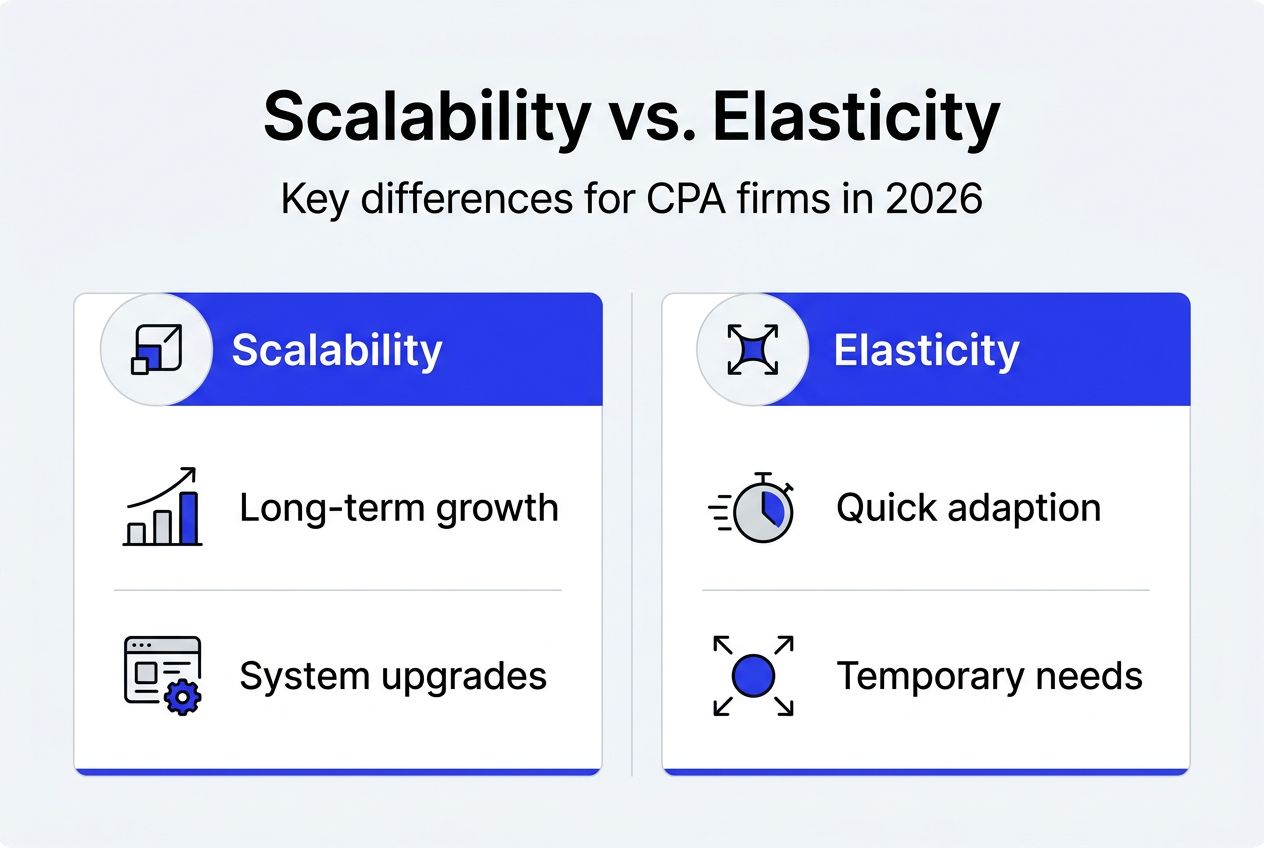
Scalability differs from elasticity; optimal digital intensity exists before diminishing gains occur because adding more technology without strategic alignment creates complexity rather than efficiency. Scalability refers to long-term capacity to handle growth, while elasticity describes short-term ability to adjust resources up or down based on immediate demand. Understanding this distinction prevents over-investment in tools that don’t align with your firm’s growth trajectory. Concave returns mean that beyond a certain point, additional digital investment yields smaller incremental benefits.
Maintainability, observability, and idempotent designs become critical as systems scale. Maintainability ensures your team can update and troubleshoot technology without vendor dependency. Observability provides visibility into system performance, identifying bottlenecks before they impact client service. Idempotent designs ensure that operations can be repeated safely without unintended side effects, crucial for automated workflows processing financial data.
| Challenge | Traditional Approach | Scalable Digital Approach |
| — | — |
| Legacy system integration | Manual data transfers between systems | API-based real-time synchronization |
| Compliance updates | Manual process changes and staff training | Automated rule engines with configurable compliance logic |
| Peak season capacity | Hiring temporary staff | Cloud resources scale automatically |
| System performance monitoring | Reactive troubleshooting after failures | Proactive observability with performance alerts |
Navigating technology modernization steps requires balancing innovation with operational stability. Rushing implementation without proper testing risks data integrity and client trust. Resistance to change among staff who are comfortable with existing processes slows adoption. Investing in IT services for accounting firms that understand CPA-specific workflows accelerates implementation and reduces risk.
Pro Tip: Avoid over-provisioning by starting with core automation needs and scaling incrementally based on measured ROI. Many firms invest in comprehensive platforms before understanding which features deliver actual value.
Applying digital scalability strategies in your CPA or financial consulting firm
Implementing digital scalability follows a structured approach that minimizes disruption while maximizing benefits. Start by auditing current workflows to identify manual bottlenecks consuming the most staff time. Tax document collection, data entry, invoice generation, and client communication typically offer the highest automation ROI. Select cloud accounting platforms that integrate with your existing tools and offer open APIs for future expansion.
- Migrate core accounting operations to cloud platforms that enable remote access and automatic updates.
- Implement AI-powered document processing to extract data from tax forms, receipts, and financial statements automatically.
- Deploy workflow automation software to route tasks, send reminders, and track completion without manual coordination.
- Integrate client portals that enable secure document sharing, report access, and payment processing.
- Add data analytics dashboards that provide real-time insights into client financial health and firm performance.
- Establish measurement frameworks to track time savings, cost reductions, and client satisfaction improvements.
CPA AI tax tools reduce processing times by 70% and admin costs by 30-40% when implemented strategically. Focus on high-volume, repetitive tasks first to demonstrate quick wins that build team buy-in. Trial phases allow you to test tools with a subset of clients before full deployment, reducing risk and gathering feedback for optimization.
Learning how to automate business processes for CPAs starts with mapping current state workflows, identifying automation opportunities, and selecting tools that integrate seamlessly. Process automation workflows should include error handling, exception routing, and audit trails to maintain compliance and quality control. Partnering with digital transformation services accelerates implementation by leveraging expertise in CPA-specific technology adoption.
| Process | Manual Time per Client | Automated Time per Client | Annual Savings (200 clients) |
| — | — | — |
| Tax document collection | 45 minutes | 10 minutes | 117 hours |
| Data entry and form population | 90 minutes | 25 minutes | 217 hours |
| Invoice generation and payment tracking | 20 minutes | 5 minutes | 50 hours |
| Client communication and updates | 30 minutes | 10 minutes | 67 hours |
Pro Tip: Select platforms designed to scale with your firm by offering tiered pricing, modular features, and integration ecosystems that accommodate growth without requiring platform migrations.
Empower your CPA firm’s growth with Transform42
Transform42 specializes in helping Miami-based CPAs and financial consultants implement digital scalability strategies that drive revenue growth without proportional cost increases. Our business transformation for CPAs services include technology assessment, workflow automation design, and implementation support tailored to your firm’s specific needs. We understand the compliance requirements, client expectations, and operational realities of running a CPA practice in 2026.
Our approach combines strategic consulting with hands-on implementation, ensuring your team adopts new technologies effectively. From selecting the right technology solutions for accountants to designing automated workflows that maintain quality and compliance, we partner with you throughout the transformation journey. Our digital transformation services have helped Miami firms scale client capacity by 50% while reducing operational costs and reclaiming hundreds of hours monthly.
Frequently asked questions
What’s the difference between scalability and elasticity in CPA technology?
Scalability refers to your firm’s long-term capacity to handle growth in clients and workload through technology investments and process improvements. Elasticity describes short-term ability to adjust computing resources up or down based on immediate demand, like adding server capacity during tax season and reducing it afterward.
What technology investments deliver the fastest ROI for CPA firms?
Cloud accounting platforms, AI-powered document processing, and workflow automation tools typically deliver measurable ROI within 3-6 months. Start with processes consuming the most manual hours, like tax document collection and data entry, where automation reduces processing time by 70%.
How do I overcome resistance to digital transformation in my firm?
Begin with pilot programs involving early adopters who can demonstrate benefits to skeptical team members. Provide hands-on training, celebrate quick wins, and show concrete time savings data. Most resistance dissolves when staff experience reduced manual work and can focus on more engaging advisory tasks.
Does digital scalability improve client experience?
Yes, significantly. Client portals enable 24/7 access to documents and reports, reducing wait times. Automated communication keeps clients informed of progress without manual outreach. Faster processing times and real-time insights position you as a responsive, technology-forward partner that delivers modern service expectations.
What quick wins can I implement immediately without major investment?
Start by digitizing document collection through free or low-cost client portal tools. Implement email automation for routine client communications like tax deadline reminders and document requests. Use cloud storage with organized folder structures to eliminate manual file management. These changes require minimal investment but demonstrate immediate efficiency gains.